
If you already have an account with Mine Safety Center but you want to buy more training, this guide will walk you through the process of adding a credit card, buying seats, and assigning those seats to users. Contact Mine Safety Center if you have difficulty.
Adding a Credit Card
Login to the training portal. Press My Account button in the upper right corner to open a drop down menu. Select the Payment Information option.
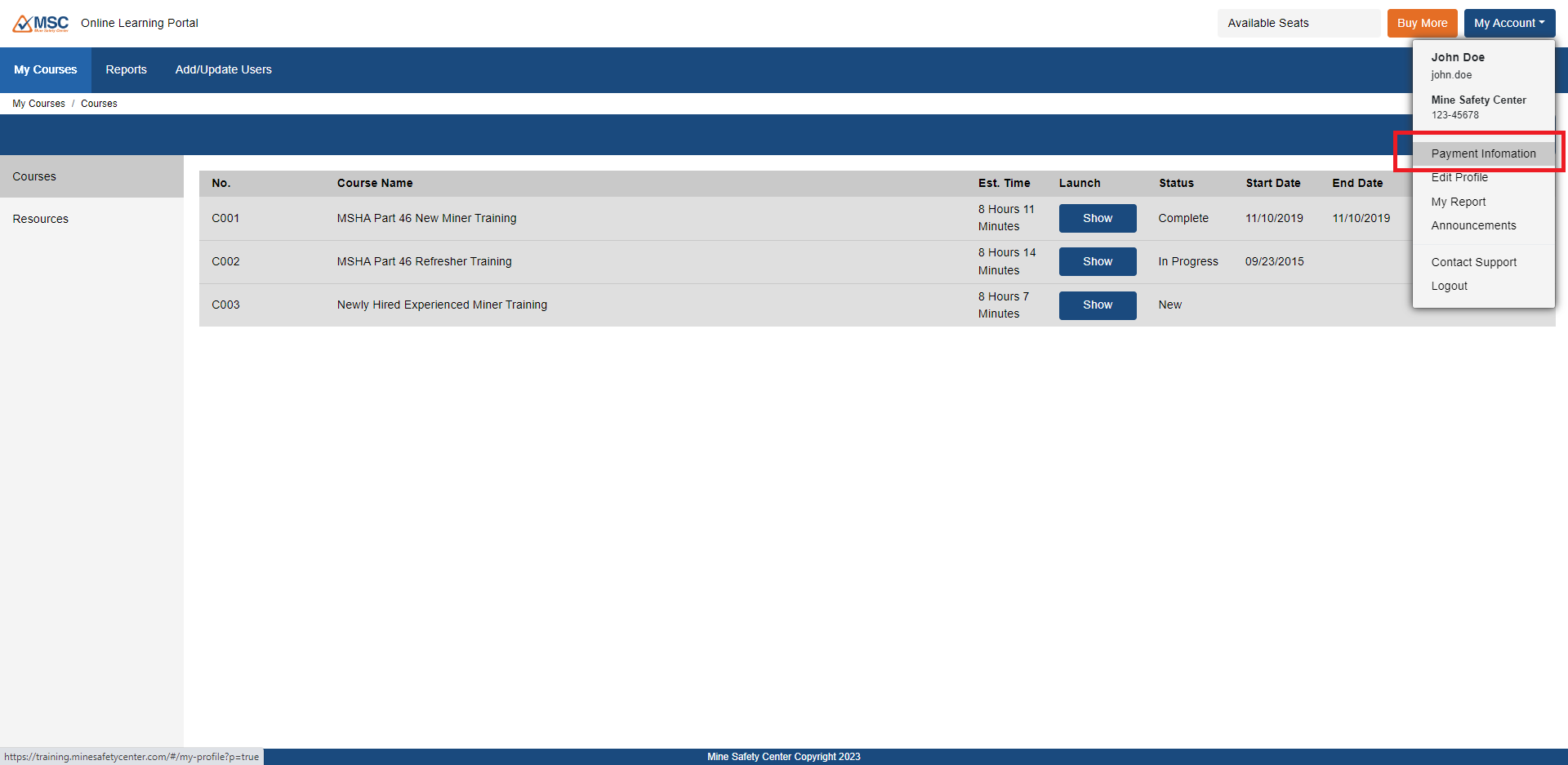
In the Payment Information section on the My Profile page, press the Add Card button on the right side.
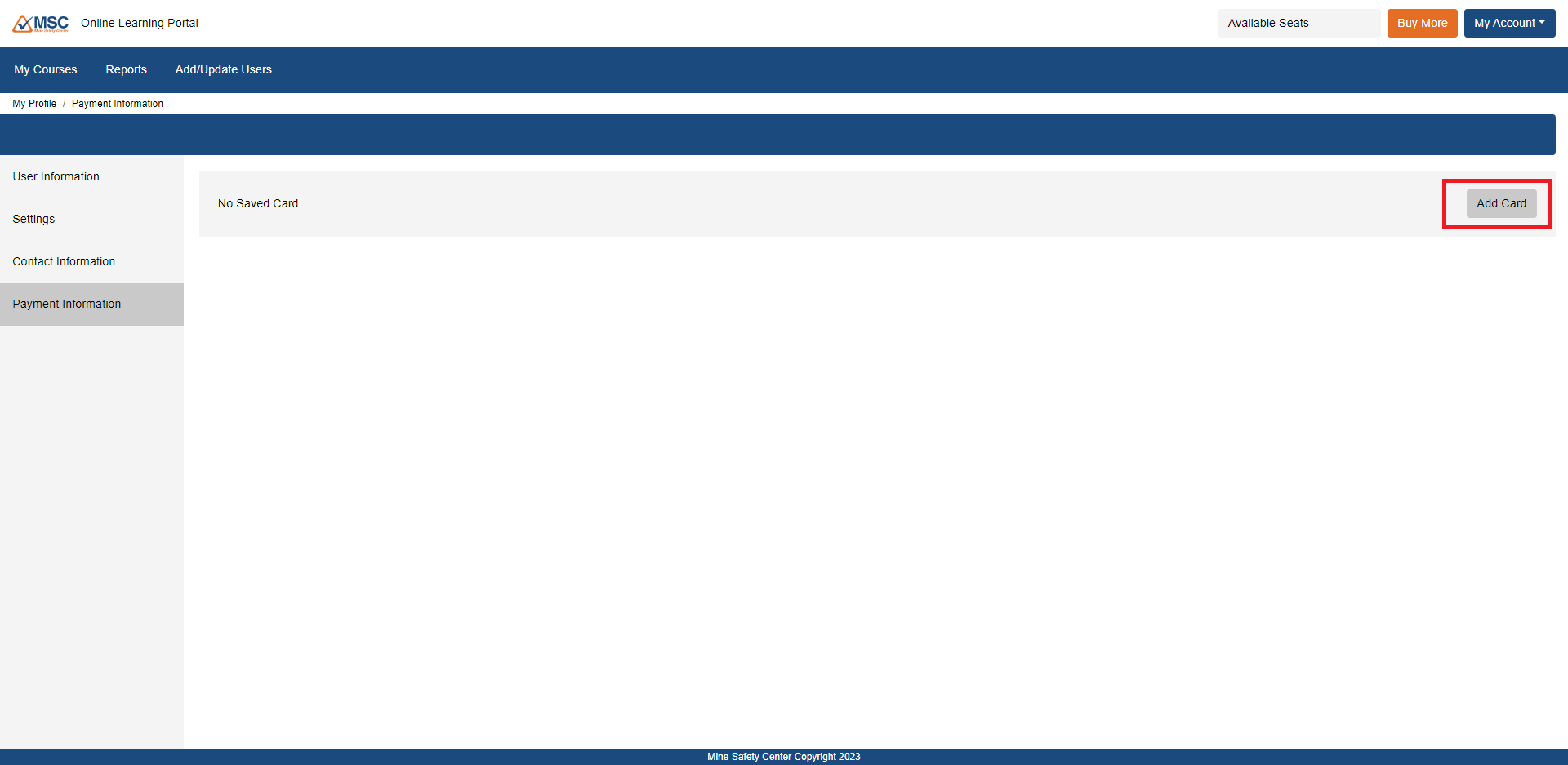
In the form, enter the required credit card information and press save.

Buying Seats
Press the Buy More button in the upper right corner.
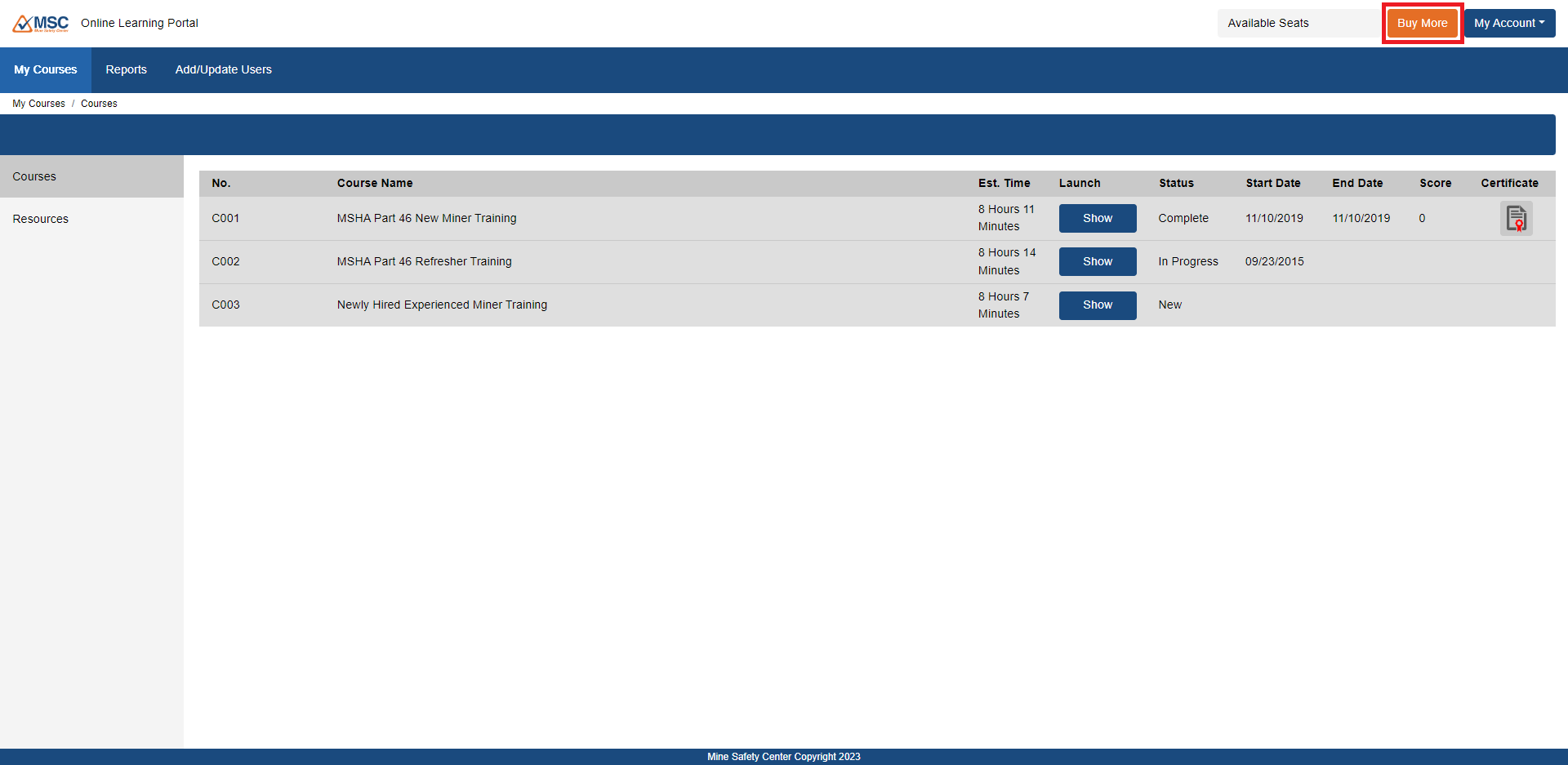
Input the number of seats for each type of training you want to purchase then press the checkout button.

In the pop-up, enter the CVV code for your credit card and press Confirm. An order confirmation screen will display. If you move your mouse over the Availible Seats bar at the top of the page, a detailed count of available seats by product will appear.
Assigning Seats to Users
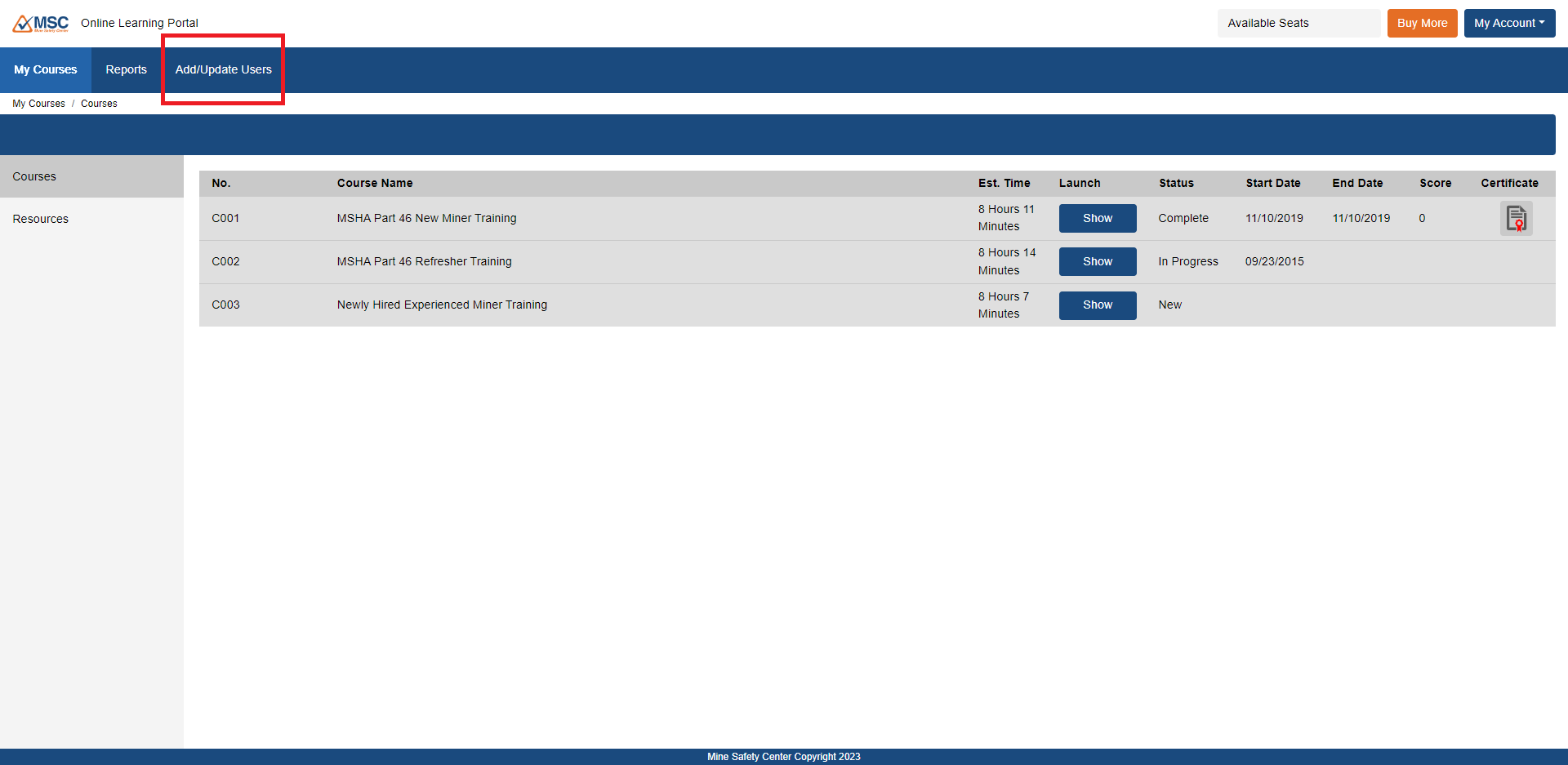
Navigate to Add / Update Users in the main menu. From here you may create new user profiles or assign seats to existing users.
Adding New Users
Press the New User button. On the next screen, enter the following requiring information:
- Username
- First Name
- Middle Name – MSHA regulations require a full first, middle, and last name on training certificates. Failure to include a middle name could result in a fine
- Last Name
- Trainings
- Companies
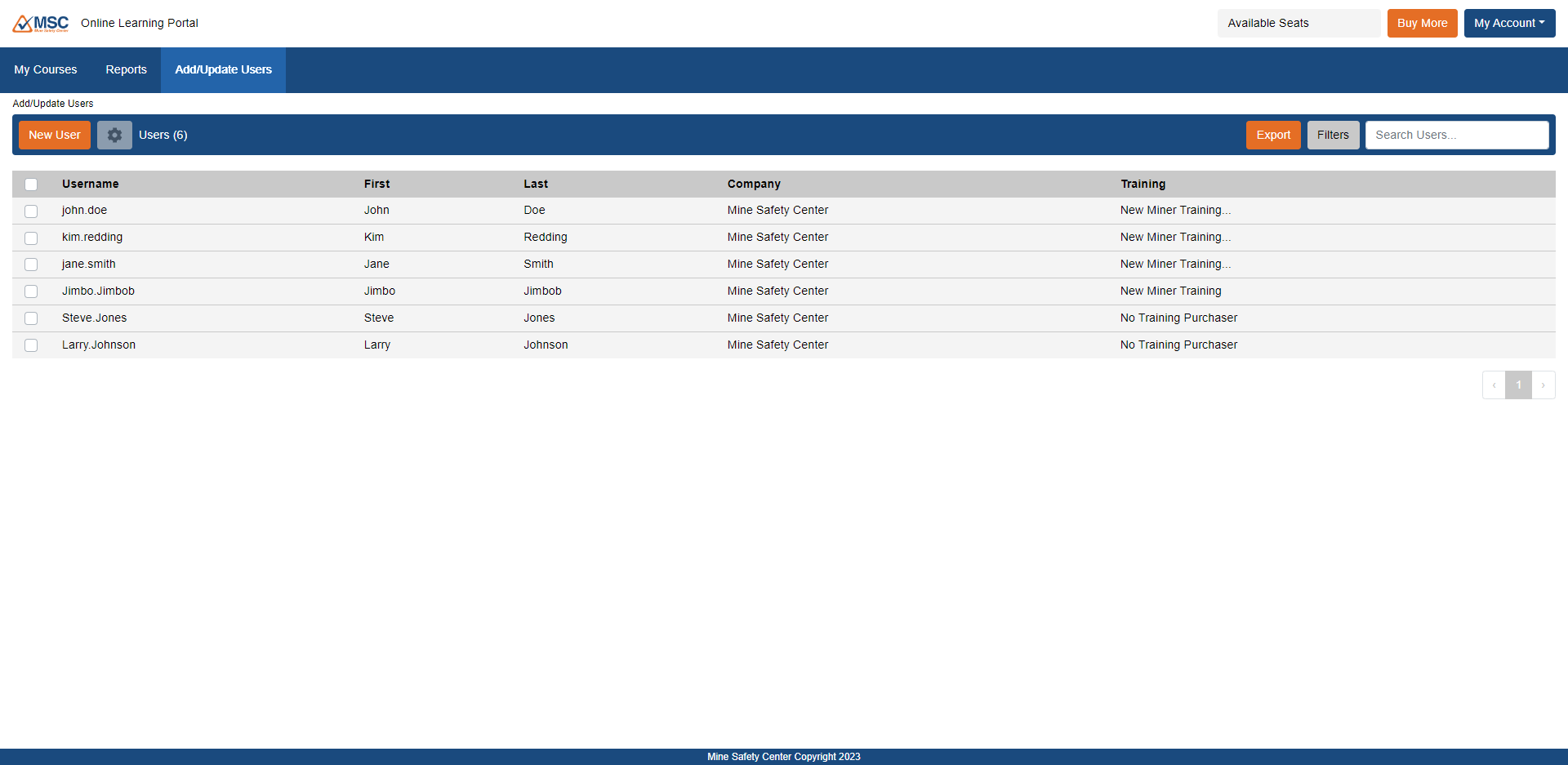
Upon pressing Save, the user will be created and the open seat will be used.
Assign Seats to Existing Users
Locate the desired user in the table and click on their username. You will be taken into their user profile.

In the Trainings dropdown, choose the training to be assigned to this user. Upon pressing Save, the training will be assigned and the open seat will be used.
Renewing Annual Refresher Training
You may renew Annual Refresher Training for a user under the following conditions:
- The user has completed a previous year’s Annual Refresher Training
- You have one or more un-used seat of Annual Refresher Training
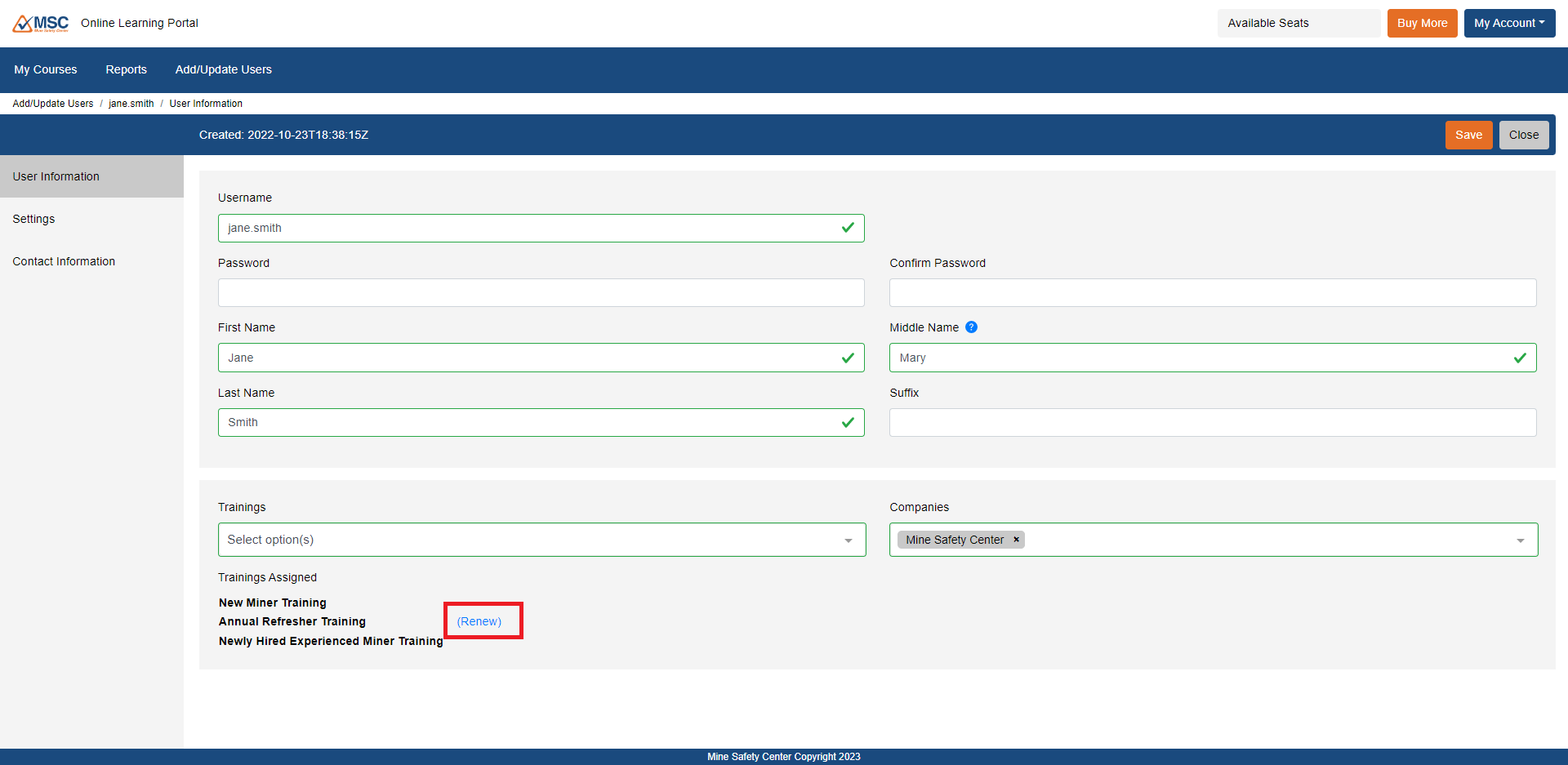
If both conditions are true, a “(Renew)” link will appear beside Annual Refresher Training under Trainings Assigned. Click the link to reset the Annual Refresher Training for the user and to use one open seat.
You’ve signed up for online MSHA training with MSC. Your employees have started their MSHA training but you want see how far along each of them are. But how do you do that? Here are step-by-step instructions for guiding you through the whole process:
Go to the Mine Safety Center Online Learning Portal and log in to your profile.

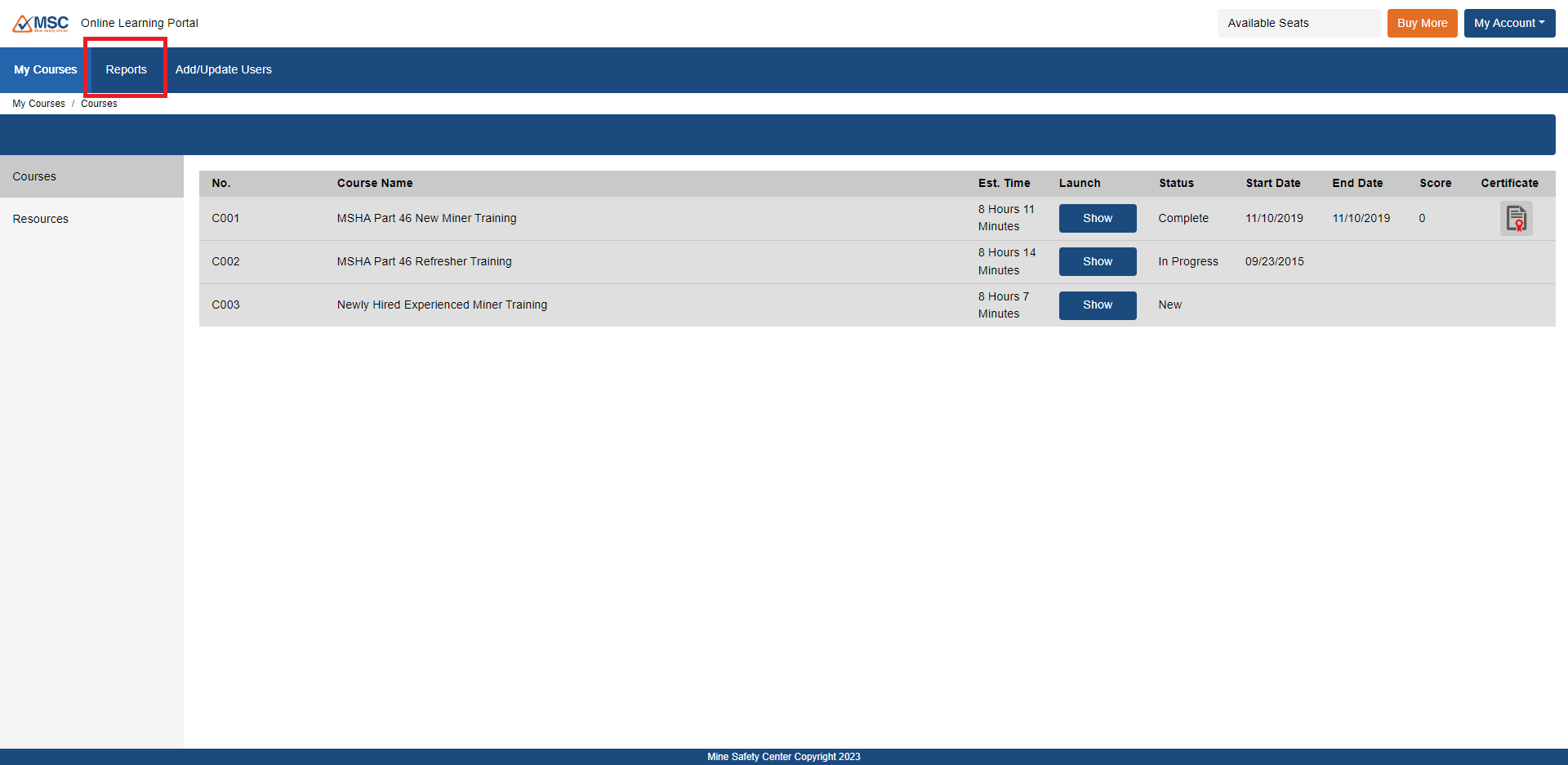
Navigate to Reports using the main menu. By default, the Student Records sub-section will open.
A list of your employees will be displayed. Use the search box, filter options, or page navigation buttons to locate employees. The column labled “# Open” will tell you which employees have courses that have not yet been completed.
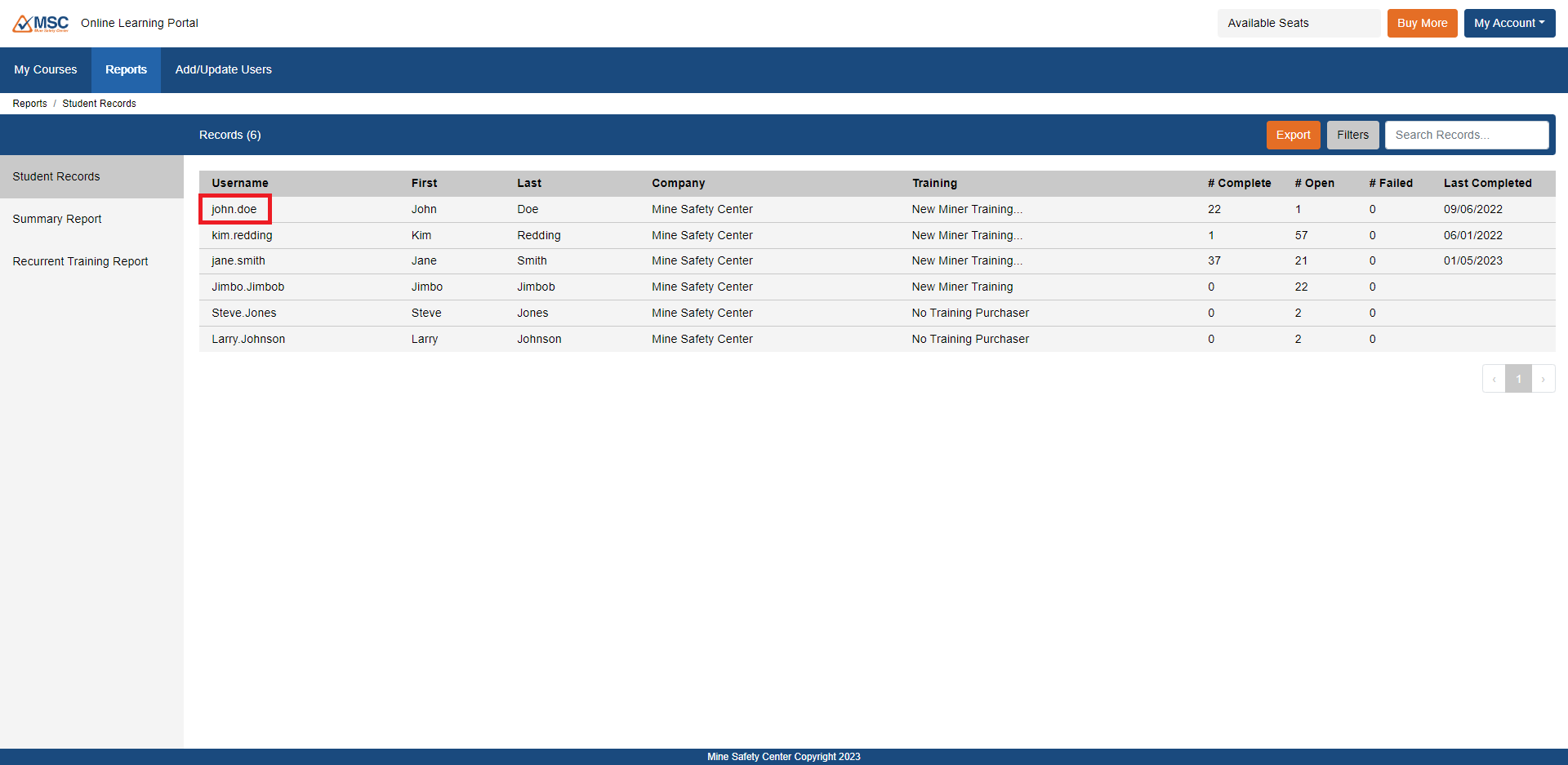
For more detailed information about a specific emplyee, click on their username. You will be taken to that employee’s individual report.
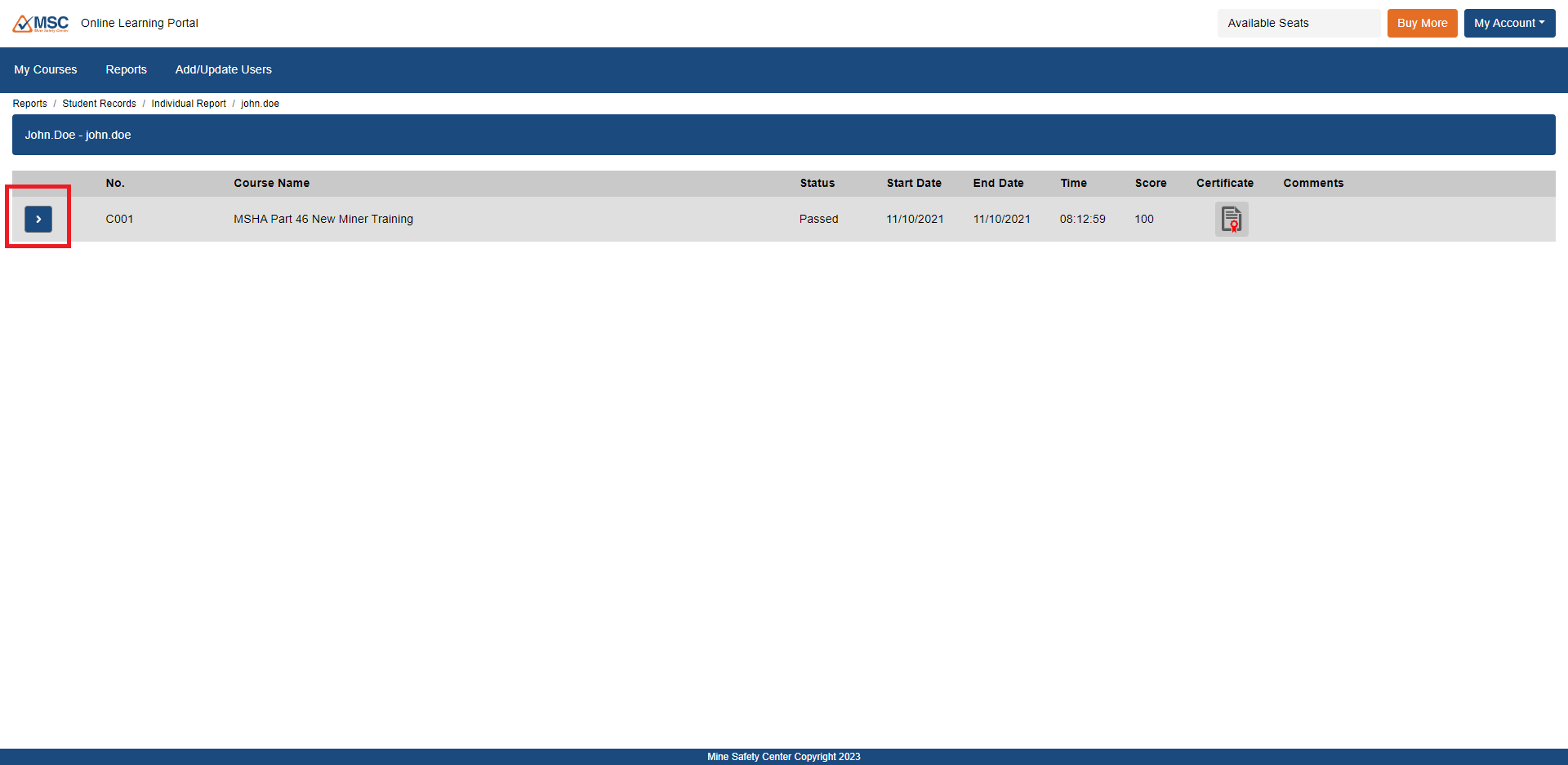
By default, the sub-modules of MSHA trainig are hidden in a collapsed view. To expand, press the arrow button to the left of the training.
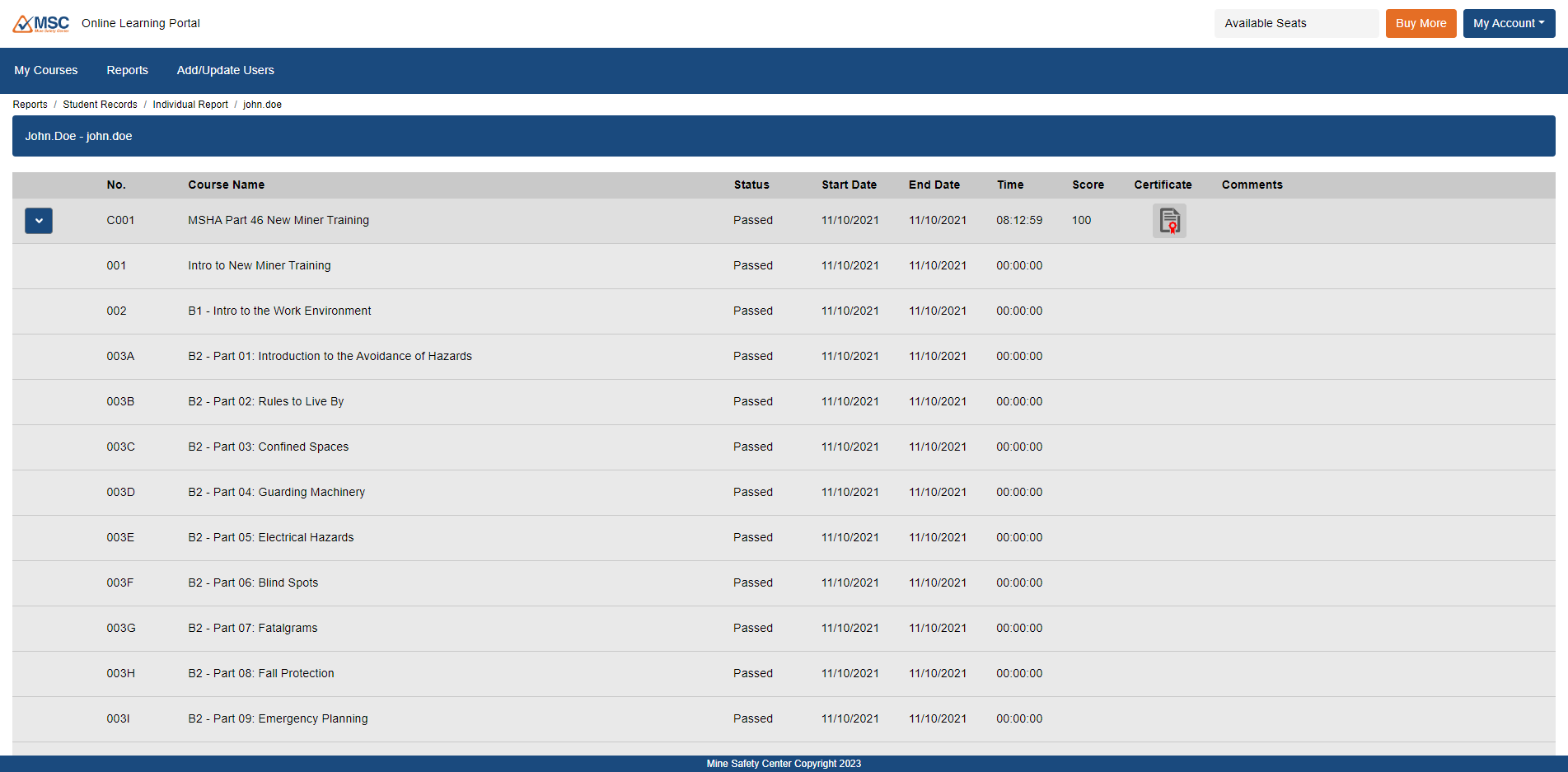
The current status of each sub-module will be listed in the status column.
Your employees have finished their MSHA training. As a manager, how do you access and print their MSHA certificates?
Go to the Mine Safety Center Online Learning Portal and log in to your profile.
Navigate to Reports using the main menu. By default, the Student Records sub-section will open.
A list of your employees will be displayed. Use the search box, filter options, or page navigation buttons to locate employees.
Upon locating the desired employee, click their username. You will be taken to that employee’s individual report.
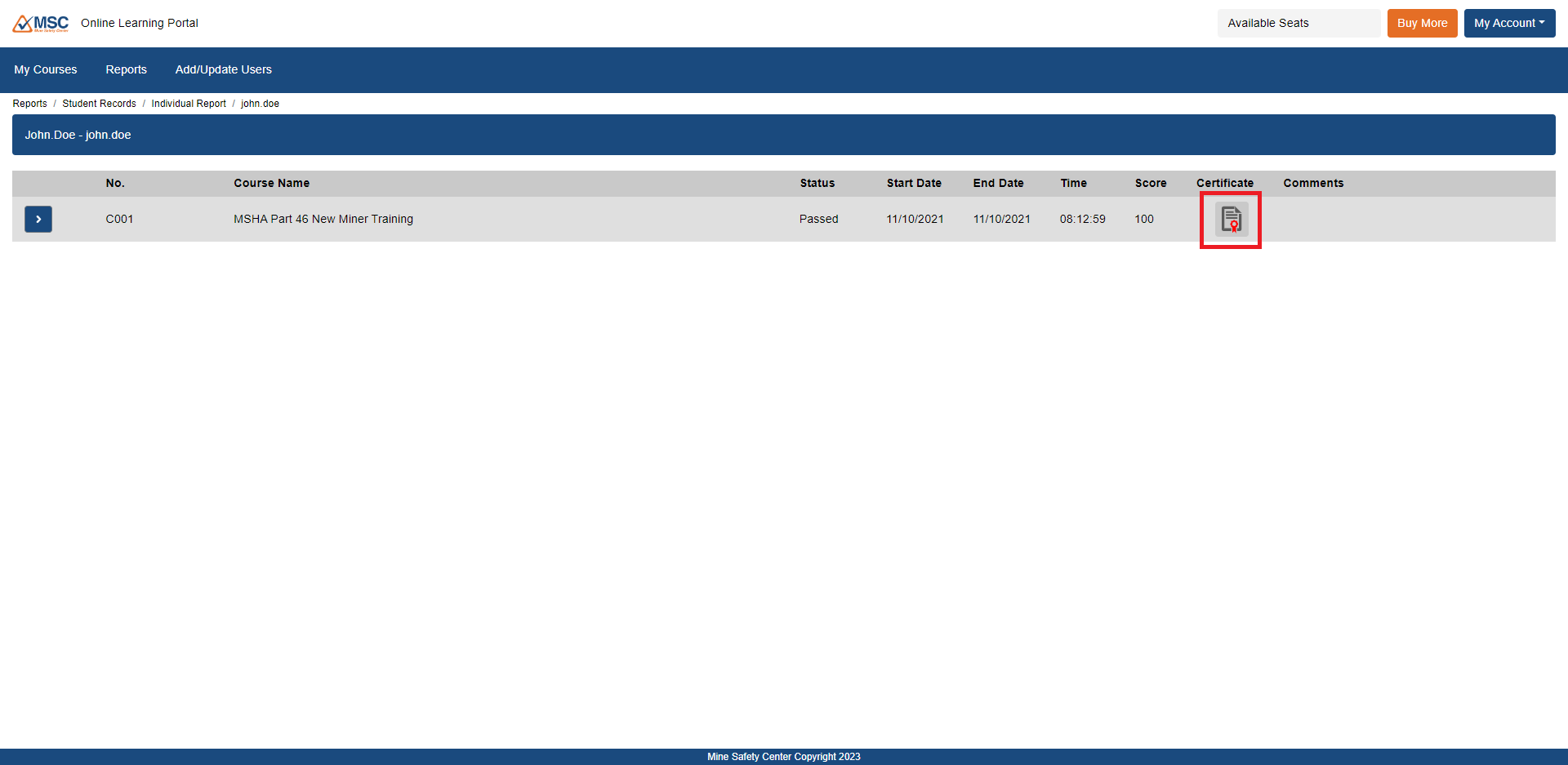
Find and click the certificate icon for the training they completed. The certificate will open in a new browser tab and may be downloaded directly or printed using the browser’s built in print options.
Experiencing one of these issues?
- The video is stuck on loading
- How do I change my password?
- I forgot my password
- Why is name and address information missing on my certificate?
The course is stuck on loading
Here are some common steps to troubleshoot issue with courses loading:
- Is you internet conenction is working? A course module should never take more than a few seconds to load. You can check your internet connection speed at fast.com
- What Internet browser are you using? We only support these common browsers:
- Google Chrome
- Mozilla Firefox
- Microsoft Edge – Included with Windows
- Apple Safari – Included with MacOS
If you’re using one of the supported browsers and still having issues, try another browser from the list.
How do I change my password?
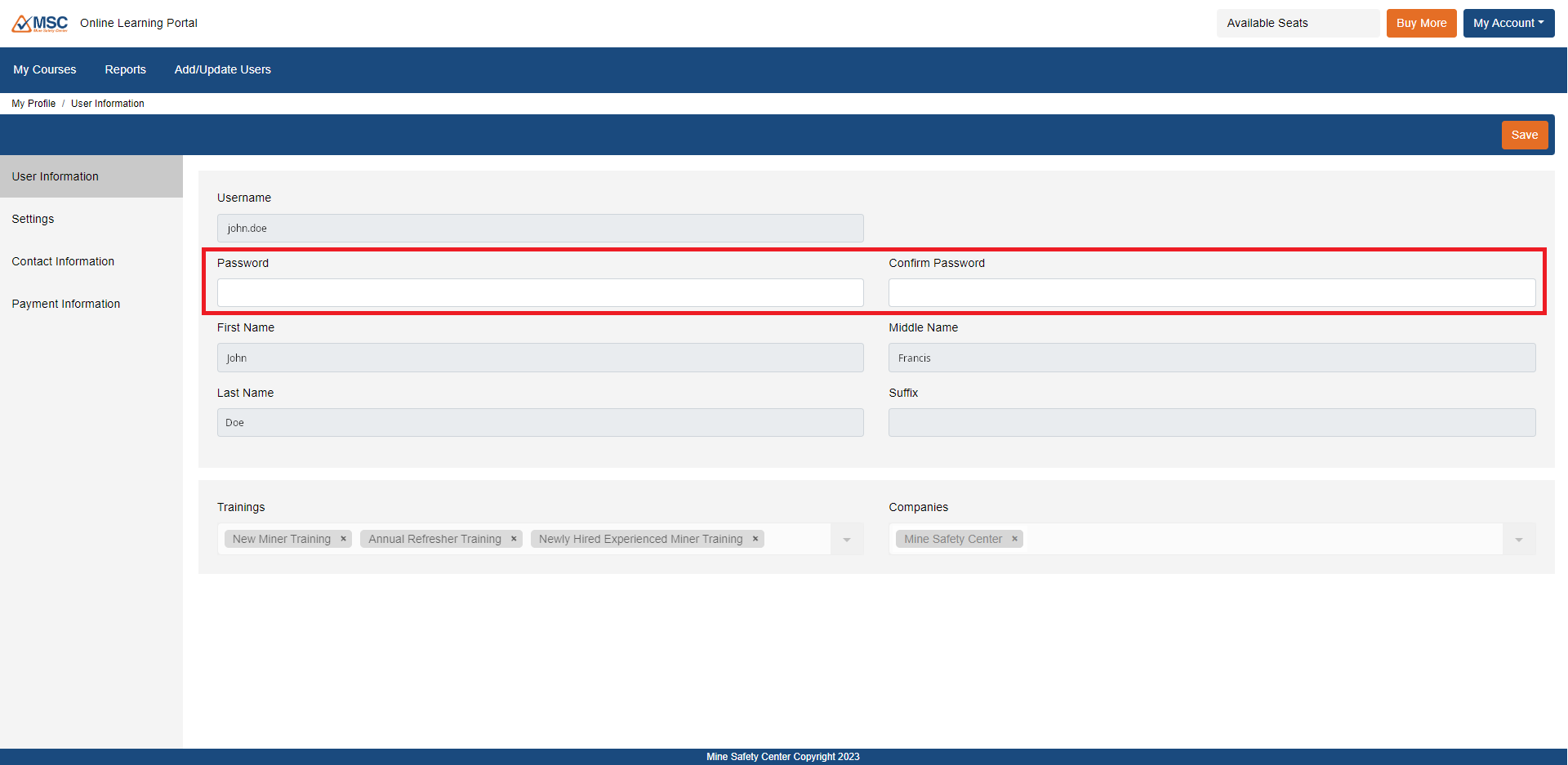
You can change your password by choosing the Edit Profile option in the My Account drop-down:
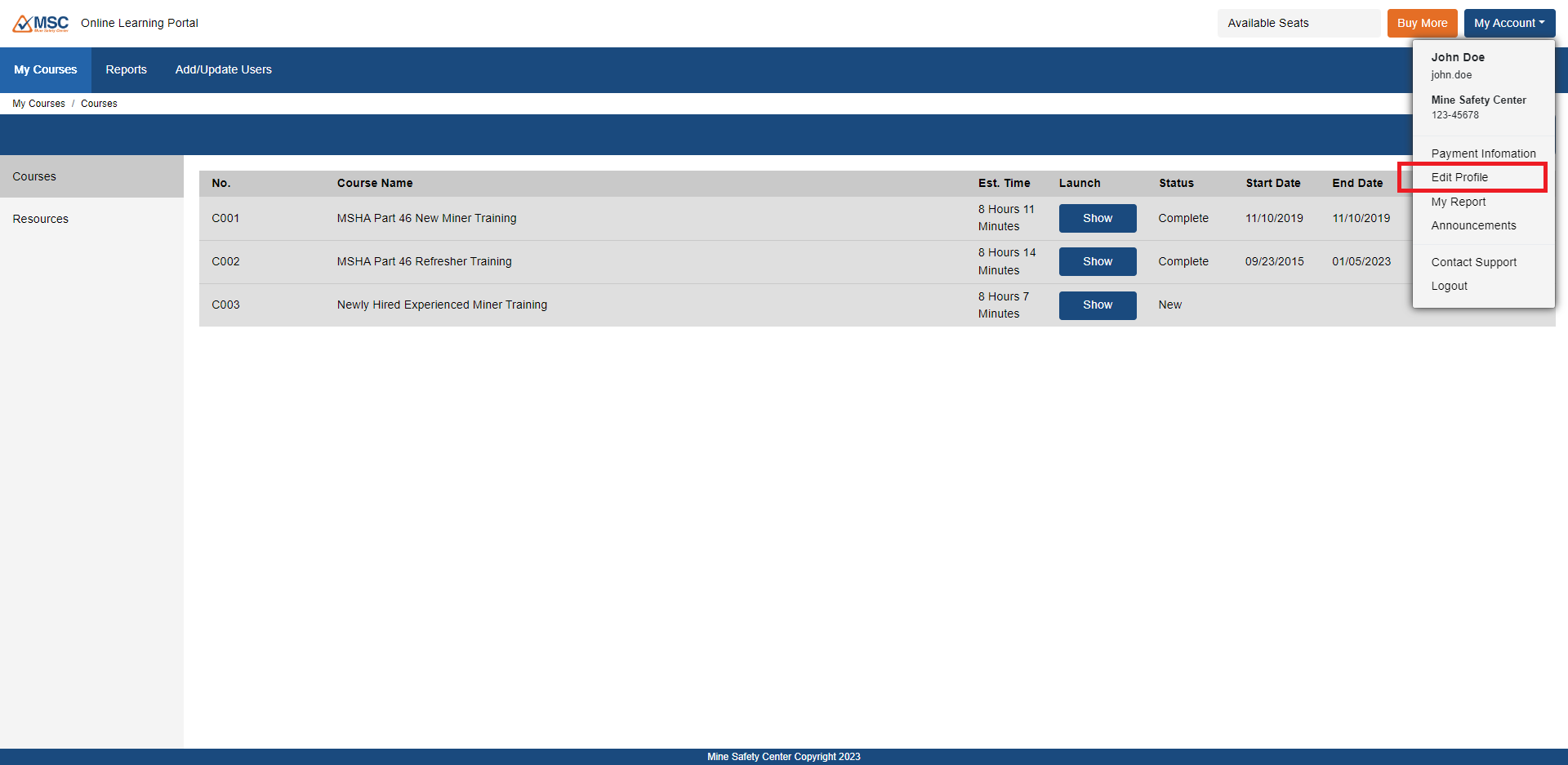
Enter your new password into both password fields and press save.
I forgot my password
You can reset your password from the login page by clicking the Forgot Password link.

On the Forgot Password screen, enter the email address associated with you account and press Submit.

If the email provided is associated with a valid account, you will recived an email containing a link to reset your password. If no email arrives within 30 minutes or your account does not have an email address attached, please contact support@insurelearn.com.
If an account was created for you by a supervior or purchased and setup by someone at your company, contact that individual for assistance.
Why is name and address information missing on my certificate?
When possible we automatically enter your personal information into the completed training certificates. However, due to the strict nature of MSHA regulations, we only automatatically enter information if we have everything. Even then, it is your responsibility to review the information on your certificate for accuraccy.
In order to have your information automatically added to your training certificate, all of the following information must be present in your log in profile:
Full Name
- First Name
- Middle Name
- Last Name
- Suffix
What if I don’t have a middle name or suffix?
If you do not have a middle name, enter a single space into the middle name field in your profile. If you do not have a suffix, you may leave that field blank.
Address
- Location of Training
- Address
- City
- State
- Zip / Postal Code
- Country
Tomorrow (April 25th) is the last day to let MSHA know that you want their disastrous new workplace exam rule delayed.
You can submit your comment right here.
MSHA has been seeking comments on its proposal to delay the effective date of the metal/non-metal workplace exam rule “to provide stakeholders training and compliance assistance.”
As Mine Industry Attorney (and friend of MSC) Willa Perlmutter puts it:
“It’s an odd basis for saying they want to extend the rule, since the need for stakeholder training and compliance assistance was surely contemplated when the final rule was published back in January. This leads me to think that MSHA is considering whether to pull (or at least, to radically amend) the rule altogether.”

MSHA Seeking Industry Comment
MSHA is looking for comments on whether or not to continue to delay a controversial workplace exams rule. NSSGA urges member companies to send comments on the rule to MSHA before the April 26 deadline.
We discussed the new workplace exam rule in detail before it was passed (and after). Now MSHA is seeking comments on whether or not to delay the rule further.
MSHA proposes to delay the effective date until July 24. Comments on MSHA’s proposal to delay the rule are due by this Wednesday, April 26.
The NSSGA has come out against the new workplace exam rule and “suggests that members use the following points in their comments:
-
The status of the rule is not clear. MSHA indicated that there was a “pause” in the rule so that the rule could be reviewed at a policy level, but that review is not yet complete. The Trump administration has also yet to appoint an Assistant Secretary to administer MSHA.
-
Once the rule is in effect, aggregates operations will require compliance assistance from MSHA.
-
The rule is still vague on what constitutes a working place, conditions that may adversely affect safety and prompt notification.
-
The rule should be delayed indefinitely until it’s status is finalized.
Comments should refer to rule RIN 1219-AB87. You can also email your comment to zzMSHA-comments@dol.gov or mail comment to: MSHA Office of Standards and Regulations, 201 12th Street South, Suite 4E401, Arlington, VA, 22202-5452.
This law will not improve worker safety. It will only lead to more citations. Contact MSHA with your thoughts now.
This guide will teach you to print your MSHA Part 46 Certificate after you’ve already completed your MSHA training with Mine Safety Center.
When you finish MSC’s Part 46 training, you still need to print your MSHA Part 46 Certificate. When all of the modules are complete, a certificate icon will appear on the My Courses page.
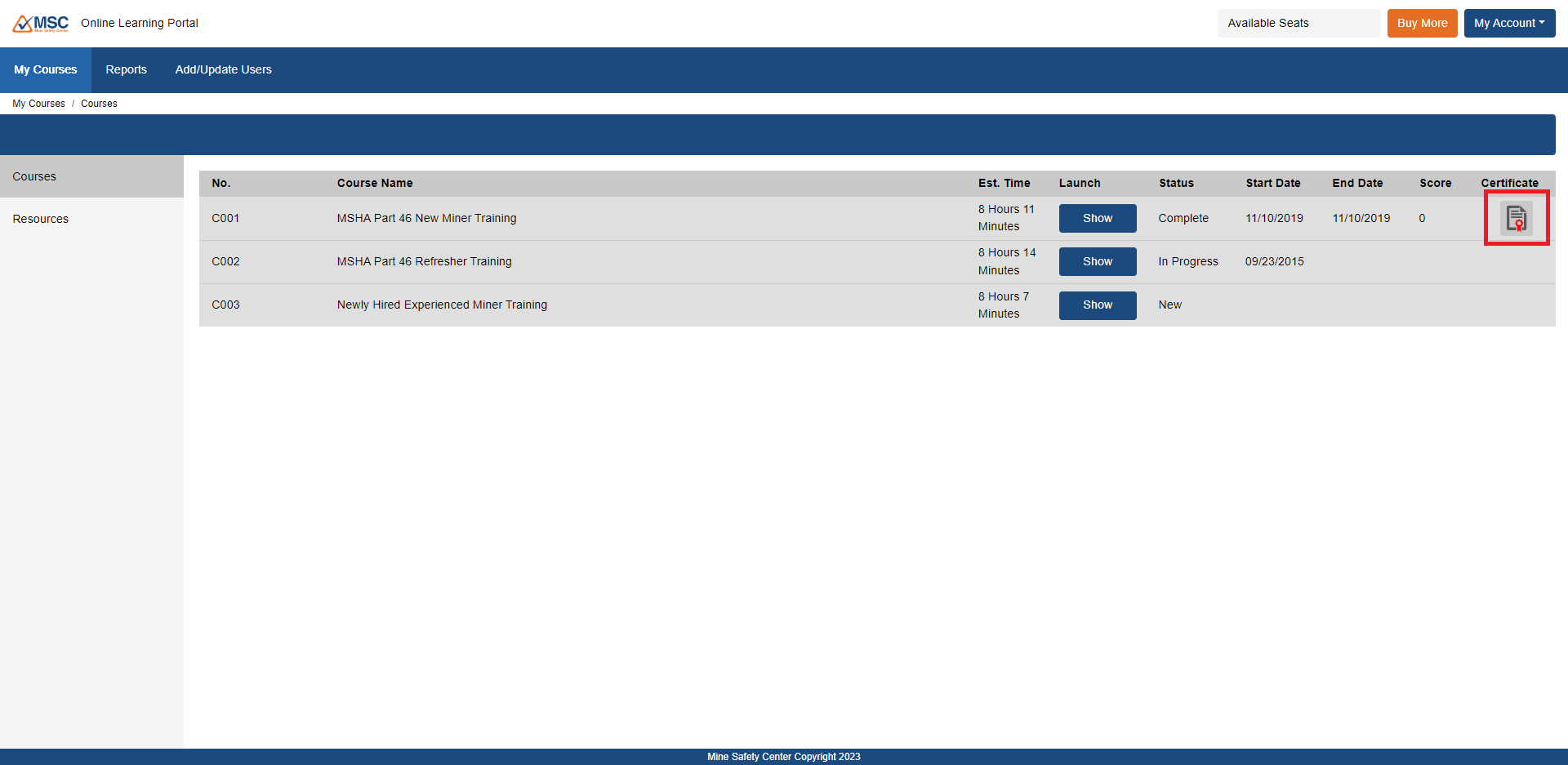
To print your MSHA certificate, click the icon. Your certificate will open in a new browser tab. Verify the information is correct. Then click the Print Certificate button at the top right. Your browser’s print options will open. The next steps to print will be slightly different from broswer-to-browser. If you wish to save the certificate as a PDF file rather than print a hard copy, look for the option titled “Save to PDF” or “Print to PDF”.
In order to get the most out of Mine Safety Center’s automatic certificate features, you need to complete information for each trainee profile, including:
- Full name as it appears on a trainee’s birth certificate including middle name (not just an initial) and any suffixes (Jr. etc.) if applicable
- The address of the location where the majority of training will take place
- The name of the training location. Is that location your office, their home, or some other location?
It’s a good idea to gather all this information before you begin updating your trainee profiles.
How To Update or Edit MSHA Trainee Profiles
Log in to the Mine Safety Center training portal
Navigate to Add / Update Users in the main menu
Use the search box, filters options, and/or page navigation to locate a specific trainee. When located, click on their username, first, or last name to edit there profile.
Your can update their full name in the User Information section.
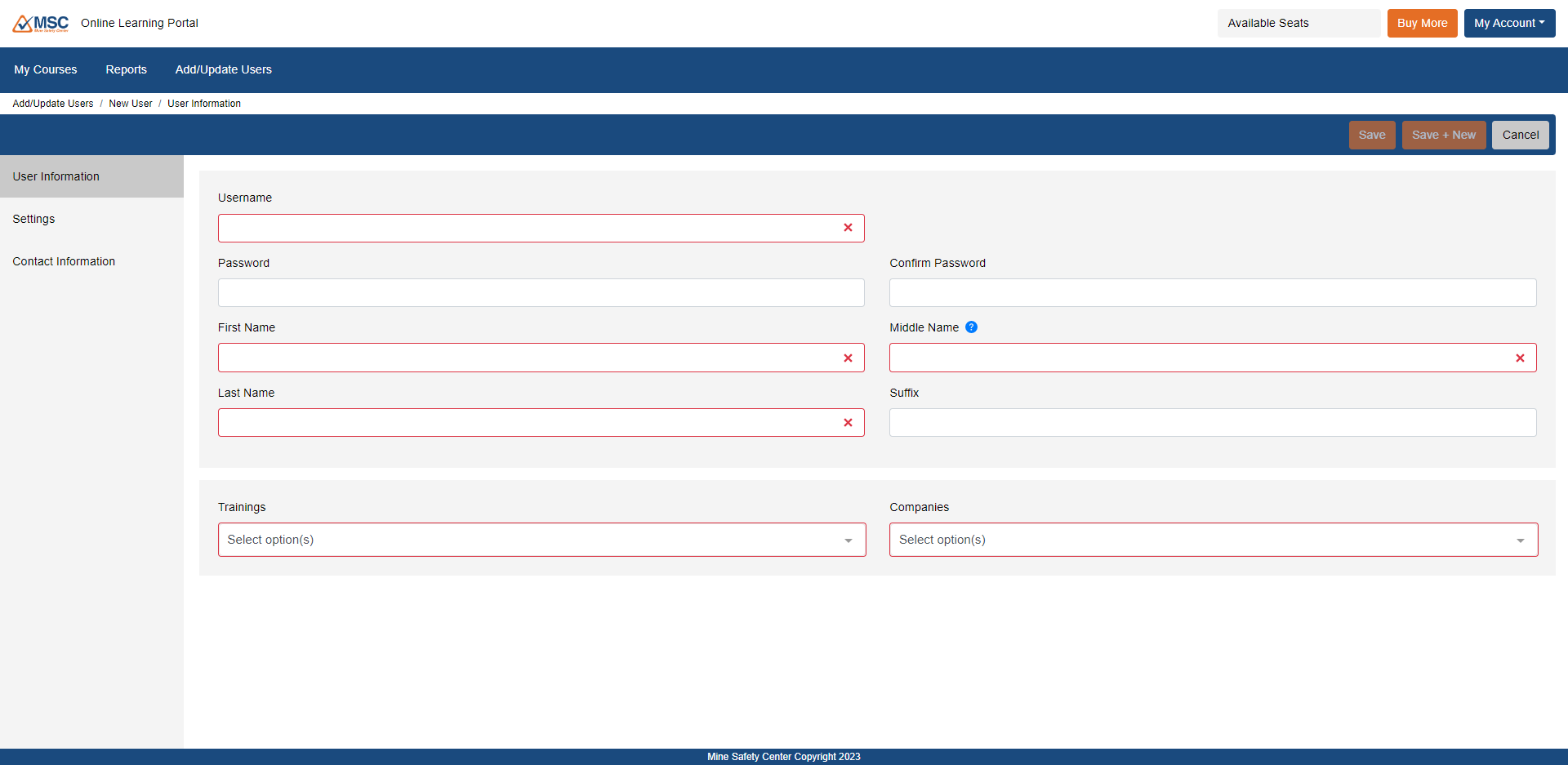
And their address information in the Contact Information section.
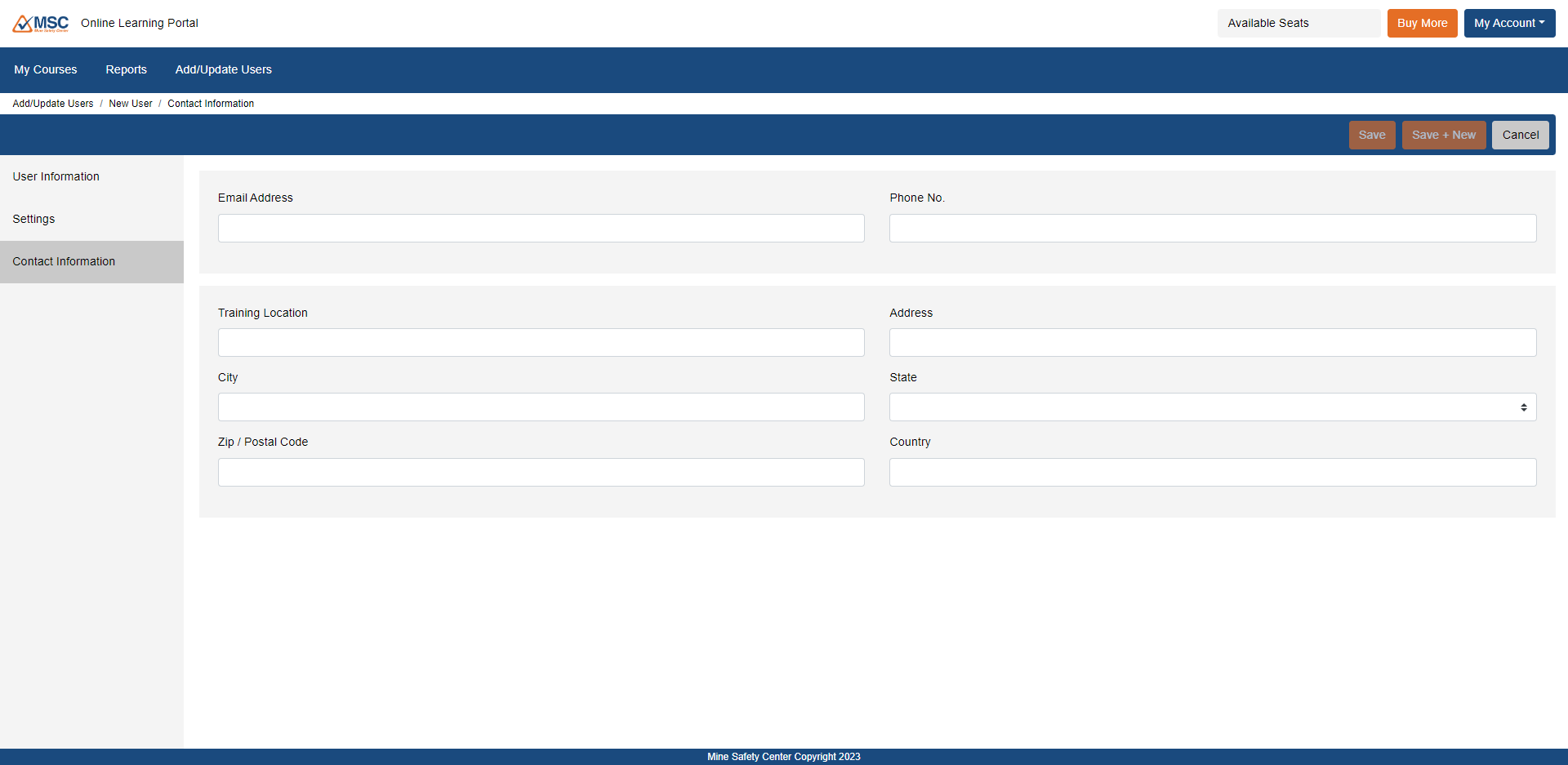
Press the Save button when you are done making changes.
We have confirmation on the updated MSHA workplace exam rule after some initial confusion around the Trump Administration’s freeze on all Obama era regulations not finalized in the Federal Register. The MSHA workplace exam rule will go into effect on May 23rd as scheduled. This means your current MSHA workplace inspection form will soon be wrong.
Has anyone come up with an MSHA workplace inspection form that meets the new requirements?
Yes, and you can get it for free. More on that later.

How did the new MSHA workplace exam rule get through?
According to Willa Perlmutter, an attorney at Stoel-Rives:
“The Labor Department’s current position is that the workplace examination rules were not affected by the memorandum and that the May 23 effective date remains in place.”
However, a new Assistant Secretary for Mine Safety and Health has not yet been named, so it is possible that the incoming head of MSHA will take steps to amend the rules or even withdraw them entirely.
. It’s full of helpful, specific information.
But There’s Good News
Upon closer inspection, the final rule has 3 significant changes from the proposed rule.
The final rule requires:
- The examination be conducted before miners are exposed to adverse conditions.
- Affected miners be notified when a hazardous condition is found.
- The workplace exam inspection form include the locations examined, the adverse conditions found and the date of the corrective action.

The proposed rule contained 3 elements that were eliminated as a result of industry push-back. These elements are:
- Provide a description of the corrective action taken for each recorded adverse condition;
- Maintain the name of the individual who performed the corrective action;
- Sign and date the workplace exam record by the examiner.
It would have been extremely difficult to comply with those rules (not to mention time-consuming and expensive as we’ve previously covered). This is a big win for common sense regulation.
Trump can direct inspectors to ignore the new workplace exam rule, right?
Here’s the deal:
Trump and the new head of MSHA can “De-emphasize” any regulation they want. But here’s 3 reasons why you should still prepare your company to comply with the updated rule:
- The Trump administration has indicated MSHA is a low priority in their administration. They might not de-emphasize the rule in the first place. And even if they do;
- The updated workplace exam rule is officially on the books. It’s a final rule. The new rule will be implemented eventually. The Trump administration and their Assistant Secretary for MSHA can decide to not enforce the rule. But as soon as a democrat comes to power they will enforce it.
- The cost of complying with the new rule is much lower than the potential cost of getting a citation and going to court.
The new workplace exam rule is going to happen one way or the other. You may as well prepare your company.
The New MSHA Workplace Inspection Form
Changing the reporting requirement means every mine in the country must change their MSHA workplace inspection form.
Look:
Making new paperwork for this rule is tricky. There are a lot of traps you could walk into.
Fortunately for you, our very own former MSHA Inspector, Kim Redding, racked his brains for the last month to create a simple, 1-page form that fulfills the new MSHA requirements.
This MSHA workplace inspection form will allow you to document an entire small or medium mine with just one page. Larger mines can just use 2 or 3 sheets to get the job done.
The best part? You can download Kim’s MSHA workplace inspection form right now – free.
An Evolving Situation
We will continue to follow this story closely. The updated workplace exam rules leave us with unanswered questions and much more to discuss. You’ll be the first to hear about it if you get our MSHA Alerts Email. If not, sign up here -free- for industry leading news and analysis, delivered right to your inbox.

It’s official, the new MSHA workplace exam rule will go into effect May 23rd, 2017. We covered this rule change when it was proposed in July. Safety officials and managers across the country had a negative reaction to the proposal, to say the least (more on that later).
What’s in the “New” MSHA Workplace Exam Rule?
Let’s review what’s happening with the MSHA workplace exam rule. There are 4 main changes that will have a massive impact on how mines across the country conduct their workplace exams.
The updated Workplace Exam standard requires:
- The examination be conducted before miners are exposed to adverse conditions.
- Affected miners be notified when a hazardous condition is found.
- A record of the examination include the locations examined, the adverse conditions found and the date of the corrective action.
And:
The final rule also requires that the examination record include: the name of the person conducting the examination, the date of the examination, the location of all areas examined, a description of each condition found that may adversely affect the safety or health of miners, and the date of the corrective action.
But the new rule isn’t new at all. This is from our article in July:
The “New” MSHA Workplace Exam Rule Has Already Been Tried and Is Ineffective
This proposed “new” rule, has been tried before and history has shown it doesn’t accomplish the goals of lowering fatalities and injuries. As anyone on a coal mine knows, a worker must have an MSHA Blue card in order to complete a coal mine workplace exam.
Essentially, MSHA has been individually verifying who is competent to conduct a coal mine workplace exam for years.
How has that worked out?
There have been huge, deadly disasters under MSHA’s watch where MSHA’s own report cited “insufficient workplace exam” as a root cause.
MSHA approved every person conducting those “insufficient” workplace exams.
Joe Mains cited the 122 deaths on M/NM sites from 2010 to 2015 as a reason this new law is necessary. But how will this standard improve safety at M/NM operations when it hasn’t worked in coal mines? Insanity is trying the same thing over and over while expecting different results.
The most insane detail comes from MSHA in the proposal itself:
“MSHA is unable to quantify the benefits from this proposed rulemaking, including the proposed provisions that an examination of the working place be conducted before miners begin work in an area”
The people proposing this rule admit there is no evidence it will improve safety. And there is a reasonable argument this rule will make miners LESS safe which we also went over this summer:
MSHA wants workplace exams conducted with documentation of all “adverse conditions” (the definition which was not clarified by MSHA, mind you) “before work can commence.”
Unfortunately, there’s a gaping hole in this thought process that could affect mines all over the country. What about the rest of the day?
A changing environment is in the nature of mining. Site terrain changes when you remove dirt. That’s a law of nature. That doesn’t even take into account constantly changing stockpiles or wear and tear on machines and tools.
Won’t the New Administration Throw Out the Rule?
Here’s the deal:
No one knows how President Trump is going to handle this. He may choose not to enforce it but there are still a lot of moving parts and Senate confirmations before anyone can make a prediction.
Even if a Trump Administration decides to delay enforcement, he can’t throw out the regulation. There is no legal way for him to take it off the books now that it has gone through the public comment period. That means eventually when a Democrat takes the White House, this rule will be waiting for their Assistant Secretary of Labor for Mine Safety.
This new MSHA Workplace Exam rule will be implemented. It’s just a matter of when. And when it is enforced you NEED to have all your ducks in a row.
What’s So Bad About This Update To The MSHA Workplace Exam Rule?
Many mine safety personnel and managers across the country spoke out against this rule during the public comment period. Let’s take a look at what they have to say.
The proposed rule is focused on workplace conditions, but not the behavior of workers.
The proposal targets a false problem. The historically low injury rates achieved by industry demonstrate a collective commitment to safe practices. These rates are not achieved by luck or by fluke: aggregates operators take their safety responsibilities seriously, including the identification of hazards and unsafe conditions. What MSHA is overlooking is that the overwhelming majority of injuries and accidents are functions not of inherently unsafe conditions but of unsafe behavior of either management or workers. MSHA’s proposed workplaces examination rule will laden operators with costly additional administrative burdens while doing nothing about the predominant source of workplace injuries – the carelessness by some in the workplace. We have seen in recent years that safety improvements focused on improving behaviors of workers are more effective at reducing injuries than ones focused on workplace conditions.
Joseph Casper, VP of Safety, NSSGA
Saving miners’ lives is important; we’d just like to see the evidence out there that this particular rule is going to advance that cause.
A real concern, however, for mine operators is that the new rule may have unintended consequences of just being another way to cite mine operators. For this rule to have validity with the workforce, it needs to be seen as protecting workers, not just as a punitive tool.
These concerns are not that far-fetched, as some recent examples of MSHA’s citations might attest to. An operator was cited for a sign that stated “no smoking, matches, or open lights” in this area, because the standard requires the same sign to say “no smoking or open flames.” One word. An operator was cited for using the incorrect font on a site-specific training checklist, and an operator was cited for not including the middle name of an employee on a task training certificate.
Brian Bigley, Safety Manager-Lehigh Southwest Cement Plant Tehachapi, Representing CalCIMA
There are hundreds of quotes like those in the public comments. We’re still grappling with the far-reaching effects of this rule change. Some of the initial issues are:
- Will MSHA workplace examination forms need to completely change?
- How will mine administrators keep up with this additional paperwork?
- Who is going to complete these new workplace exams? Management? Workers? Do workers need to be listed as “Competent People”?
- How will MSHA inspectors interpret “adverse condition”?
- How will management make sure every “adverse condition” noted on a workplace exam form is then followed with when it was fixed?
We’ll try to answer all of those questions (and the dozens I’m sure will pop up) in future articles.
3 Mine Safety Tips for Changing of Seasons
I think you’ll agree with me when I say:
Mine safety is a constant work in progress.
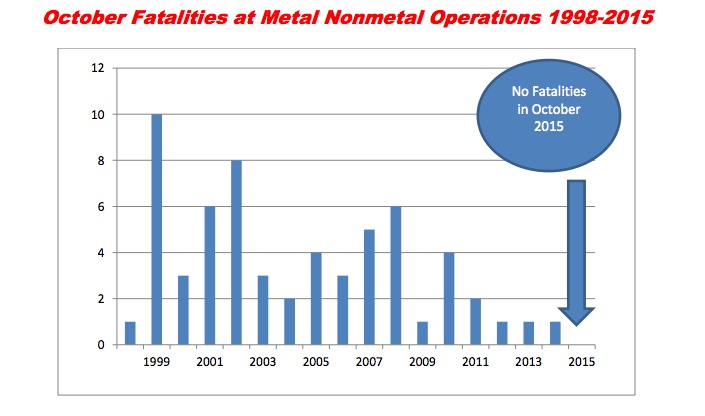
Sure everyone buys in during training and safety events, that’s good. But the true test of a safety culture is when your team needs to hit a deadline during the most dangerous month of the year. As MSHA reminds us, “October historically ranks as the deadliest month in metal and nonmetal.”
And in today’s post, I’m going to show you 3 hidden dangers that could impact your company’s safety this fall.
Changing Season Dangers – Don’t Let One Mistake End a Life
MSHA’s yearly reminder highlighted the “need for the entire mining community to refocus efforts on preventing these tragedies.”
Unfortunately, the letter didn’t give any specifics. I was hoping it would include actionable safety steps for companies.
Well, it looks like we’re going to do this ourselves. I spoke with mines safety expert and former MSHA Inspector, Kim Redding. During our call, Kim discussed some unique reasons the change of seasons is so dangerous and some simple ways you can avoid those dangers.
The most obvious danger during changing seasons is from the weather. Most of us know that transitioning weather patterns and added moisture cause all kinds of issues on mine sites. I won’t get into the physical dangers because I’ve discussed them extensively in a previous article.
3 Dangers of Changing Seasons You Might Not Consider and What To Do About Them
This article takes a look at dangers you might not see; dangers hidden in your co-workers’ heads.
Mental lapses can be just as deadly as the machines you work with.
1. Rushing Workers Under a Deadline
“One of the biggest reasons for accidents during the fall is rushing to get projects done,” Kim said.
Companies and workers are under 3 time constraints at this time of year: deteriorating weather, less daylight, and looming deadlines.
As summer turns into fall, weather deteriorates and the days get shorter. Bad weather and less sunlight makes working conditions much more difficult. But projects still need to get finished.
On top of that, many companies are under contractual deadlines.
“Let’s use road-paving projects as an example,” Kim continued. “Those jobs have to get done before it gets too cold to pave. I have to lot the companies I get fined daily for every day they don’t meet their deadline; big fines that are written into the contract.
Now, machine breakdowns are normal throughout the year. But if you have one more breakdown than you expected, all of a sudden you’re paying to pave the road.”
Who wouldn’t be racing to finish a project under that kind of pressure? Workers are preoccupied, just trying to take care of everything as fast as they can.
But that’s when accidents happen.
Prevent Accidents With A Simple Shift In Mindset
Notice when you or your coworkers are rushing and call it out. Never sacrifice safety for speed. You can work quickly without rushing.
Remember “The Tortoise and the Hare”? Your Grandmother saying “A stitch in time saves nine.”
There’s a reason that moral has been around for ages. Sometimes you need to slow down to go fast.

If you need to finish a job quickly, an accident or breakdown will only make everything take longer. (Not to mention the potential for tragedy that would be an injury or death)
If you’ve had a lot of lost time to breakdowns this year, you may want to look at your pre-op exams. Spotting damage before it gets worse can save you a lot of time and money in repairs. Investing a bit of time in retraining your crew can pay off big.
Simple? Yes. Does everyone do it? Unfortunately, no.
When we get busy it feels like we don’t have time for preventative maintenance. It’s human nature. But that’s when you need preventative maintenance matters most. Accidents, injuries, and broken equipment have a much higher cost than a couple extra minutes for a thorough pre-op.
What should you look for in a pre-op?
That will depend on your job and the machinery you’re using. But Kim’s free Pre-Operational Exam template is a great place to start.

Get a free mobile equipment pre-operation checklist from a former MSHA inspector
2. Distraction Leads to Danger
The change of seasons brings distractions at home too.
Kim said “I see it when I’m training. I’ll ask guys what do you think takes your mind from the job?’ And the most common reasons I hear are:
- All the things I need to finish before winter at the job and at my house
- The holidays are coming up and I need to start planning trips and thinking about presents
- It’s hunting season
Kim continued, “through interviewing workers I find things they say takes their mind off the job and managers at mines can too. External distractions may not be something managers take into account but you need to.”
Proactively Fight Distraction
The best way to fight distraction is to openly discuss it. Co-workers should be accountable for themselves and each other.
Notice if your mind starts to wander. What’s causing you to lose focus? Acknowledge the distraction then refocus on the job.
Keep an eye out for your co-workers. Do they seem engaged? Do you need to tell them something a few times? Call attention to it.
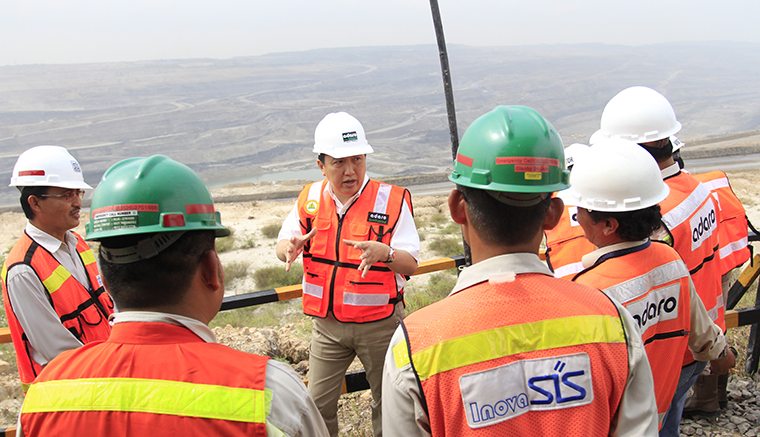
If someone isn’t paying attention during a task, don’t start until you get their attention.
Simple stuff, but it could save a life.
3. Unfamiliarity or Uncertainty With Yearly Tasks
Here’s the deal:
A job’s risk dramatically increases when workers are unsure or unprepared for the task they’re performing.
Closing or preparing a mine for winter only happens once a year. While workers may have been trained on a task or procedure, training fades over time without repetition.
Workers complete mine closing tasks far less often than their day-to-day jobs, leading to unfamiliarity.
Unfamiliar Tasks Are New Tasks
Completing yearly tasks has killed or injured a lot of experienced workers over the years. You can do the same job once a year for 15 years and still get tripped up. There’s just too much lag time. Not to mention the small changes from year to year that always affect jobs.
That’s why you should always approach a yearly or unfamiliar task as a new task.
Research the task, discuss it, and plan it out before any work starts.
Your team needs to know the plan and their role within it. Everyone must be able to follow the plan throughout the job.
To recap, you can dramatically improve mine safety by highlighting 3 fundamental practices
- Pre-Operational Exams can – and do – save lives
- Proactively Fight Distraction and Rushing
- Discuss and Thoroughly Plan All Intermittent Tasks
Newly Proposed MSHA Workplace Exam Law is Unnecessary, Counterproductive, and Ineffective. The Good News? We Can Still Stop It.
MSHA is pushing for new, unnecessary rules again. This time they’re holding public comment meetings for a potentially disastrous MSHA workplace exam law.
The proposed rule change was immediately met with a chorus of skepticism from industry leaders when it was introduced last month.
MSC co-founder, Kim Redding, attended the first public comment meeting in Salt Lake on July 19th with a representative of our partner organization CalCIMA. Both experts had an opportunity to ask questions in an attempt to clarify potential troubling points within the proposed rule change. Kim’s goal was to discern the agency’s goals and motives in pushing for the new MSHA workplace exam law.
Unfortunately, our suspicions were confirmed.
MSHA is honing workplace exams from a blunt instrument for handing out fines to a razor sharp axe. This new rule will affect everyone: mine workers, mine management, owners and even mine contractors.
How? I’ll go through that in detail in a bit.
First, we need to go over the current rule and how it compares to the proposed regulation.

The Current MSHA Workplace Exam Law
The existing regulation requires that “a competent person designated by the operator shall examine each working place at least once each shift for conditions which may adversely affect safety or health” and then “promptly initiate corrective action to correct such conditions.” In addition to this examination and corrective action, the operator is also required to maintain a record that the examination was conducted. Under the existing rule, any imminent danger that the operator identifies must be brought to the immediate attention of management, and all persons are to be withdrawn from the affected area.
The current workplace examination rules (30 CFR Part 56 and 57) have also gotten significantly stricter over the past 2 years through program policy letters. Kim even addressed the Program Policy Letter changes to Workplace exam in a video update:
MSHA inspectors already lack consistency from one person to the next. The new MSHA workplace exam law would only make this problem worse.
What is the proposed MSHA Workplace Exam rule?
According to MSHA’s press release the new workplace exam rule would require that:
- A competent person examine the working place before miners begin work in that location.
- Mine operators promptly notify miners of any conditions that may adversely affect their safety or health.
- A competent person sign and date the examination record before the end of each shift. The examination record must include a description of locations examined, conditions found and corrective actions taken.
- Records must be made available for inspection by MSHA and miners’ representatives, and operators must provide a copy of the records upon request.
At the meeting, Kim and our partner CalCIMA representative attempted to get clarification on the glaring ambiguities within the new rule. Unfortunately, the Question and Answer session can be boiled down pretty easily:
Q: What is MSHA’s definition of “adverse conditions”?
A: MSHA representatives would not get specific.
Q: How are the mine operators supposed to inform everyone on site of an “adverse condition” discovered in a workplace exam
A: MSHA representatives did not have an answer
Q: Kim asked MSHA about the end game for this new rule. Why create a new rule when we already have one and it was the safest year ever last year?
A: MSHA’s representatives dodged the question.
The full transcript of the hearing will be online in 2 weeks. I’ll dive into more specific questions and arguments then. But for now, let’s look at the information we have.
What’s The Endgame?
MSHA claims they’re not changing the current rule but industry experts have been through this process before. If the rule wasn’t changing, why devote huge amounts of valuable time and government resources making this change?
MSHA’s goal is clear:
There’s a long list of reasons this rule change is a bad idea. Keep reading for what a former MSHA inspector has identified as the 3 worst potential consequences of this law:
1. The “New” MSHA Workplace Exam Law Has Already Been Tried and Is Ineffective
This proposed “new” rule, has been tried before and history has shown it doesn’t accomplish the goals of lowering fatalities and injuries. As anyone on a coal mine knows, a worker must have an MSHA Blue card in order to complete a coal mine workplace exam.
Essentially, MSHA has been individually verifying who is competent to conduct a coal mine workplace exam for years.
How has that worked out?
There have been huge, deadly disasters under MSHA’s watch where MSHA’s own report cited “insufficient workplace exam” as a root cause.
MSHA approved every person conducting those “insufficient” workplace exams.
Joe Mains cited the 122 deaths on M/NM sites from 2010 to 2015 as a reason this new law is necessary. But how will this standard improve safety at M/NM operations when it hasn’t worked in coal mines? Insanity is trying the same thing over and over while expecting different results.
2. The New Rule Could DECREASE Miner Safety
This law would not improve safety and may actually make workers less safe. Constant assessment of the work environment is the strength of the current MSHA workplace exam law.
But in the new rule, MSHA wants workplace exams conducted with documentation of all “adverse conditions” (the definition which was not clarified by MSHA, mind you) “before work can commence.”
Unfortunately, there’s a gaping hole in this thought process that could affect mines all over the country. What about the rest of the day?
A changing environment is in the nature of mining. Site terrain changes when you remove dirt. That’s a law of nature. That doesn’t even take into account constantly changing stockpiles or wear and tear on machines and tools.
How is MSHA defining a competent person? MSHA would apply the Part 46 competent person standard to this rule change. This would force managers to declare anyone who is doing a workplace exam a “competent person” Why? MSHA wants to “hold specific workers accountable” (read, heavily penalize) if anything changes between the time of workplace exam and work occurring. I’ll get into the specifics on that in a few seconds.

This New Rule Could Have Disastrous Results. Here’s How:
Let’s go through a scenario that will DEFINITELY happen if this new rule is put into place:
A miner in Wyoming conducts his workplace exam before beginning operations (as required by the new law). Let’s call him Jim. Jim’s boss wants to start work at 8 so Jim completes his workplace exam and paperwork at 6am.
It’s early fall in Wyoming, so the temperature is 25 degrees when Jim is conducting his workplace exam. But by noon the temperature jumps to 55 degrees. A temperature swing like that will dramatically change conditions at the quarry:
- As temperatures rise, ice melts which causes water to seep and erode areas within the high wall
- Large rocks are fall from the high wall face as erosion occurs and the center of gravity changes
- The high wall naturally heaves as temperatures rise
All of these changes are dangerous, potentially even deadly.
But they can be observed and avoided with the proper procedures, training, and a constant workplace exam.
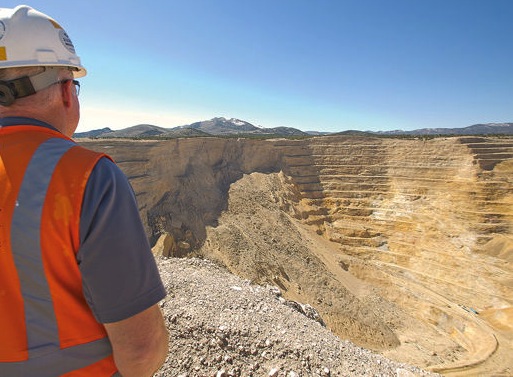
What if an MSHA inspector shows up at noon and takes a look at the workplace exam Jim conducted at 6am? Conditions have definitely changed. Under the new rule, that’s a violation and a giant fine for Jim’s company and maybe his personal bank account.
Why should Jim and his company get fined for the earth’s response to temperature swings?
How big is Jim’s personal fine? What does that do to his family? The MSHA can use the IRS to enforce personal fines. Does that drain Jim’s college fund for his kids?
On top of that, Jim’s managers are all open to personal fines.
Think this is overly dramatic? Think again. Kim learned MSHA’s tricks and tendencies when he was an inspector. The ambiguity within this proposed rule would be used as a weapon whenever an inspector chooses. This “hypothetical” situation WILL occur.
3. New MSHA Workplace Exam Law Will Affect Every Employee (And Contractor) At Every Mine
As I mentioned at the beginning of this article, this new rule would open up every worker on a M/NM site to personal fines and liability. When the new rule proposal was announced last month, Doran and Nightengale pointed out that:
These new requirements present significant enforcement liability exposure for mine supervisors. Past enforcement experience has demonstrated that MSHA will focus closely on any conditions and issues identified in workplace examination records to evaluate management’s knowledge of hazards. Identified conditions that cannot be matched up with corresponding corrective actions will then form the basis for allegations of “aggravated conduct” to support the issuance of 104(d)(1) “unwarrantable failure” citations and orders. MSHA will, in turn, use those citations to initiate 110(c) special investigations to determine if agents of the operator have “knowingly violated or knowingly authorized the violation of” a mandatory safety standard. The workplace examination record will likely be the primary evidence of this agent knowledge.
Jim’s scenario above? It could happen to:
- Mine Workers
- Mine Managers
- Contracting Companies
- Human Resources for both the mines and their contractors
If you think the mining industry has an issue attracting talent now… just wait until potential employees hear about a low-level worker having his financial savings wiped out for signing a piece of paper.
Or as Nick Scala put it on the MSHA Defense Report:
At a time when mines are already experiencing problems with finding miners willing to become agents of management because of the fear of prosecution by MSHA, the proposed rule could amplify that issue. The requirement to sign and date the examination report, and its potential to create unintended liability issues, will be a major hurdle, if this rule becomes finalized in the current form. As an examiner would be certifying that a working area is free of hazards, or that all hazards were recognized in an area, the likelihood of a Section 110 action, or personal lawsuit, in the event of an injury or death is more ominous than ever.
Every single person on a mine will have their financial stability in the balance – Every Day – if this new MSHA workplace exam law gets through.

I think we’ve established this proposed rule is a potential disaster for both safety and mine workers.We need to stop the proposed new MSHA workplace exam law, but how? What can you do about it?
Tell MSHA Why This Proposed Law Is A HUGE Mistake
Getting your opinion on the public record makes a massive difference in a rulemaking case like this. Telling MSHA what you think could be the difference between this proposal becoming law and not.
Here are the 5 ways you can help stop this rule change:
- You can comment on the proposed rule change here.
- Go to the final public comment meeting for this proposed rule. The meeting information is: August 4, 2016 – Sheraton Birmingham Hotel, 2101 Richard Arrington Jr. Boulevard North, Birmingham, AL 35203 – Contact Number: (205) 324-5000
- CALL MSHA Directly. The correct phone number is: (202) 693-9400
- Mail MSHA at: MSHA, Office of Standards, Regulations, and Variances, 201 12th Street South, Suite 4E40
- Or our personal preference:
MSHA requires a “competent person” to deliver and sign all Part 46 training and paperwork. But that raises a lot of questions with very few clear answers. What exactly does “Competent Person” mean? Who decides if someone is competent and how? Does our competent person need to be MSHA approved? Does my MSHA competent person need to provide all of our training?
You’ll get an answer below to the most frequently asked Part 46 MSHA competent person questions. And if I don’t answer your question, let me know in the comments. I want this article to be as useful for you as possible.
What is the Definition of an MSHA Competent Person?
According to 30 CFR § 46.2 (d), MSHA’s Definition of a Competent Person is:
“A person designated by the production-operator or independent contractor who has the ability, training, knowledge, or experience to provide training to miners in his or her area of expertise. The competent person must be able both to effectively communicate the training subject to miners and to evaluate whether the training given to miners is effective.”
A bit vague, no? On top of that, there is a completely different (and more strict) set of rules for MSHA Part 48 trainers – more on that later.
Let’s get more specific.
Who decides if a person is qualified to be an MSHA competent person?
According to MSHA, a Competent Person must be “designated by the production-operator or independent contractor.” Essentially, management chooses who is a competent person.
What qualifications does a Part 46 MSHA competent person need in order to fulfill MSHA part 46 training requirements?
MSHA says “ability, training, knowledge, or experience to provide training.” Basically, do you know the job well enough to teach it to someone else. The competent person can also be overseeing a trainee taking an online MSHA course or watching a mine safety video
When is a competent person required?
A competent person is needed any time a company must complete Part 46 MSHA training. This includes New Miner Training, Annual Refresher Training and even Task and Site-Specific Training.
Does a Part 46 Competent Person need to be “MSHA Approved”?
No, Part 46 (§ 46.4(a)(2) to be exact) does not require MSHA review or approval of any competent person. This is extremely different from MSHA’s Part 48 trainer requirements.
How does a company officially designate a Competent Person?
Every company’s competent person must be listed in the cover letter of their Part 46 MSHA Safety Training Plan. There is no limit to the number of Competent People a company can list.
Does the Operator or Contractor Need to Explain the Rationale for Choosing an Individual as a “Competent Person” or Justify their Training Background?
No. Part 46 does not require companies to document the background of a competent person. Choosing a Competent Person is left at the company’s discretion.
MSHA may question companies “in cases where MSHA has reasonable concerns that an individual designated as a ‘competent person’ does not have the necessary expertise to instruct or to evaluate the effectiveness of the training.” But this is rare.
You know who’s qualified at your company. Just use your best judgment.
Does the same standard apply to Part 48 trainers?
No, the competent person standard only applies to Part 46. Part 48 training must be conducted and verified by a trainer with an MSHA Blue Card. A Blue Card trainer goes through extensive testing and must be approved by MSHA to receive their certification.
Only a Blue Card MSHA trainer can sign a Part 48 5000-23 form.
How do I know if I’m on a Part 46 or a Part 48 site? What’s the difference between Part 46 and Part 48?
This is one of our most asked questions.
In fact, we get this question so much that we created a tool to get you immediate answers. Just fill out a few simple questions on MSC’s free Part 46 or 48 tool and instantly get an expert’s answer.
What does the Competent Person need to cover during the MSHA training?
That depends on what type of Part 46 training they’re conducting. You can go here for detailed information on MSHA’s Part 46 training requirements.
Can a competent person who provides training to miners be credited with the training they provide?
Yes. A competent person can apply any training they instruct toward their own training certification requirements. It may feel weird filling out and then signing your on MSHA paperwork, but the practice is MSHA approved.
Can a contractor list their client, the mine operator, as a competent person?
Yes, in fact many times it’s required. Under § 46.4(b), you may arrange with a mine or independent organization to provide all or part of your training, including site-specific hazard awareness training. However, site-specific hazard awareness training must be conducted by an organization that has access to the site and is knowledgeable about the site-specific hazards at the mine.
Section 46.3(b) specifically provides that you must indicate in your training plan the organization and/or the competent person who will provide the training. If a mine is providing the site-specific, they must be listed on your training plan.
Does all of a company’s training need to be conducted by the same competent person?
No, and sometimes this won’t even be possible. Trainees can get instruction from any number of people as long as the trainer is qualified in the subject and listed as a competent person in the company’s Part 46 training plan.
Does a contractor’s MSHA Competent Person need to be on site when they’re working?
No. The employer must ensure that a competent person performs designated duties defined in 30 CFR § 46.2(b). The employer must also ensure that all employees are trained to recognize developing hazards. The competent person doesn’t need to oversee operations.

“Enhanced” MSHA Rules To Live By Enforcement Begins July 1st, Will Affect Both Operators and Contractors
In a press release distributed on June 26th, MSHA announced “Enhanced” enforcement of its MSHA Rules To Live By standards.
MSHA’s news release states:
On July 1, the U.S. Department of Labor’s Mine Safety and Health Administration will begin enhanced enforcement of “Rules to Live By,” its initiative of standards commonly cited following mine deaths, and nine underground coal mine exam rule standards focused on the greatest risks to miners in underground coal mines.
While 2015 was the safest year ever for mining in the US, it appears Joe Mains is determined for one final push during the last few months of his tenure.
In the announcement of this push, Joe Mains states:
We will more extensively employ our web-based calculators on Rules to Live By and the exam rule to determine the number of respective citations and orders issued during the most recently completed inspection periods for which data are available. Inspectors will provide mine operators with a copy of the results, encouraging them to use the tools to monitor their own compliance and take action to eliminate violations. The results will be added to criteria for consideration of impact inspections, particularly targeting mines with elevated noncompliance of these standards.
You know what that means…
Enforcement initiatives are nothing new with this administration. But there are signs that this might be especially far reaching with large numbers of coal inspectors potentially flooding the M/NM sector.
“Since the [MSHA Rules To Live By] programs began, MSHA has issued more than 45,000 “significant and substantial” citations and orders for violations of Rules to Live By standards. More than 15,000 citations and orders were issued for violations of exam rule standards since implementation of the rule. These represent violations MSHA has cited during mine inspections on critical, frequent hazards that cause or contribute to fatal mining accidents. Mine operators need to conduct site examinations to find and fix conditions and hazards if miners are to be better protected,” said Mains.
That number is bound to climb steeply in the coming weeks.
Prepare Your Operation and Contractors For “Enhanced” MSHA Rules To Live By Enforcement
Go over your operation with a fine-toothed comb, obviously with a heavy focus on the Rules To Live By Enforcement Standards. Here is a link to the MSHA Rules To Live By standards. And here is an MSHA document outlining what inspectors look for when focusing on Rules To Live By standards.
But you should also go through your paperwork. Make sure you have the fully completed New Miner training certificate for every employee. Make sure every employee is task trained for every job they conduct and tool they use to complete their work.
If you have any contractors working on site make sure they’re informed. I’d recommend doing an audit on their MSHA compliance yourself. That way if you find anything, they have time to correct the issue before MSHA shows up.
Dedicate significant time to this audit. A thorough self-inspection could save you a lot of time and money down the road.
And if MSHA does show up at your operation watch out for the tricky tactic I wrote about last week that some MSHA inspectors use to triple MSHA fines.
What Else Can You Do?
Forward this information to your colleagues. Everyone needs as much time as possible to audit their operations and get prepared.

Here is the entire press release:
MSHA launches enhanced Rules To Live By enforcement to encourage better examinations by industry’s operators
ARLINGTON, Va. – On July 1, the U.S. Department of Labor’s Mine Safety and Health Administration will begin enhanced enforcement of “Rules to Live By,” its initiative of standards commonly cited following mine deaths, and nine underground coal mine exam rule standards focused on the greatest risks to miners in underground coal mines. The agency announced these measures on May 12, 2016, at a mining industry stakeholder meeting in Arlington.

How A Few Words Cost Thousands in MSHA Fines
MSHA inspectors are at your mine for one reason: to find violations and write tickets. Once they find a violation, they must determine how they should mark the violation to assess MSHA fines.
One of the major determining factors for marking MSHA fines as “Negligence” or “High Negligence” is how long management knew about a violation without taking action. When I was an MSHA inspector I would always ask “How long has that existed?” when writing a ticket. Many times inspectors will suggest how long a violation existed. Something like, “It looks like that’s been broken for a few years, don’t you think?”
This is where you can really step in it.
Some managers agree thinking it will get the inspector off the property faster. Instead, they may have tripled the MSHA fine up to $242,000.
How? You probably already know. The manager confirmed a time frame.
If you don’t know how long a violation has existed that should be your answer, “I don’t know.” Nothing more.
I’ve seen 3 words cost a mine operator $7,000. Here’s How:
To fill fuel the tank at this mine, a person must climb a ladder with a fuel hose. Recently, an inspector came to the site and pointed out that the person climbing the ladder can’t keep 3 points of contact because they need one hand to hold the fuel hose.
While the inspector is right and the tank should be (and was) corrected, this fuel tank has been repeatedly inspected for literally decades with no warnings, no MSHA citations, and no MSHA fines.
The inspector then asked my client, “How long has this tank been like that?” This leading question prompted the 3 words that cost my client $7,000.
“Heck, 25 years.”

By agreeing to a time frame, he acknowledged that he knew a violation existed and did nothing to fix it – even if he didn’t know it was a violation. And that is how a violation escalates from low or moderate negligence to high negligence or reckless disregard.
(Oh, and since you’re in management, making this mistake can also expose you to personal MSHA fines – going after YOUR bank account – as high as $242,000. But that’s another post.)
What he should have said was…
“That was a violation? I didn’t know. No one has ever said that was a violation before.” Don’t accept the premise of his leading question.
You can even lose money when the inspector is wrong
That’s right. You can lose money if an inspector incorrectly cites a condition as a violation.
I’ll give you an example from a client in the northwest.
At this particular mine there is roadway on top of a hill with a slope on either side. A little while ago a new inspector was at this mine and decided this roadway needed berms and the mine was in violation. The inspector asked how long the road had been like this. The owner’s response?
“About 30 years.”

That’s a major MSHA fine. It’s also incorrect.
The MSHA regulation for berms states:
30 cfr 56.9300(a) – Berms or guardrails shall be provided and maintained on the banks of roadways where a drop-off exists of sufficient grade or depth to cause a vehicle to overturn or endanger persons in equipment.
This roadway was compliant with MSHA regulations. Unfortunately, my client accepted the premise of this inspector’s question. Even though it wasn’t a violation the mine operator received a $23,000 ticket.
Yes, the operator can fight the ticket and win. But legal fees will cost almost as much as the ticket and take a significant investment of his time. Going to court also comes with a big risk. Depending on the judge, he could lose his case which would cause him to pay the ticket AND his attorney.
Prevent MSHA Fines By Spotting Incorrect MSHA Citations Before They’re Filed
He should have argued the ticket on the spot with something like, “What’s the problem? You guys have inspected my site for years and that’s never been an issue. Why didn’t all the other inspectors think this was a violation?”
If after this conversation the inspector still believes it’s a violation, the operator should have been issued a warning with the chance to re-mediate.
But because he slipped up, this operator paid the fine plus the cost of fixing the berm (which also caused weeks of downtime).
The simple question of “how long has that existed?” opens a nasty can of worms.
If someone at your site falls into this trap you’ll be getting a visit from a Special Investigator.
How is a Special Investigator different than an MSHA Inspector and what should you do if one is on your site? That’s a topic for another day.


MSHA Inspector Actions and Transfers Are Cause For Industry Concern
I think you’ll agree when I say complying with MSHA regulations is harder than ever. Regulations seem to vary wildly from one inspector to the next. You never know what will happen when an MSHA inspector shows up.
MSHA seems determined to constantly push (and expand) the boundaries of federal regulations.
This week there were serious signs that MSHA will be stepping up their M/NM enforcement even further and is pushing for more jurisdiction – yet again.
MSHA Inspector Crosses The Line
Our expert, Kim Redding, reports that MSHA is attempting to claim jurisdiction over commercial sales yards, even if they don’t have any mining activity. MSHA has no precedent for claiming jurisdiction (more on that later) and has – to our knowledge – never previously attempted to regulate commercial sale yards.
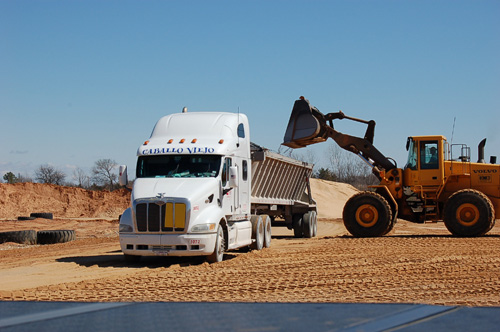
This new development occurred while Kim was conducting an on-site audit for of his client mines in the Northwest. His client operates a Sand and Gravel pit with a connected sales yard where they both store material and load customer trucks.
Recently, an MSHA inspector showed up while the operation was closed. Normally this would cause the inspector to return when the mine was open for business. But not this one.
This MSHA inspector claimed that being open or closed is “a formality” (which it’s not) and began his inspection.
And when I say he began his inspection, that included the commercial sales yard that does not fall under his jurisdiction. This site has been in operation for years and never been inspected by MSHA.
He asked for everyone’s MSHA training certificates and other compliance documents. He inspected a Front End Loader that only worked on the sales yard filling customer trucks. I think you can guess, how that went….
On top of that, he forced the operator to TURN ON their processing plant and create product so he could inspect the shut down plant. This is the first time we’ve ever heard of this kind of an incident.
Here’s the thing:
There have been rumors that MSHA is angling for expansion of their jurisdiction to include recycling, concrete and asphalt plants. This week’s attempt appears to further those suspicions.
And the agency certainly has a well documented history of expanding their jurisdiction whenever they get an opportunity.
Why does MSHA want to expand their jurisdiction?
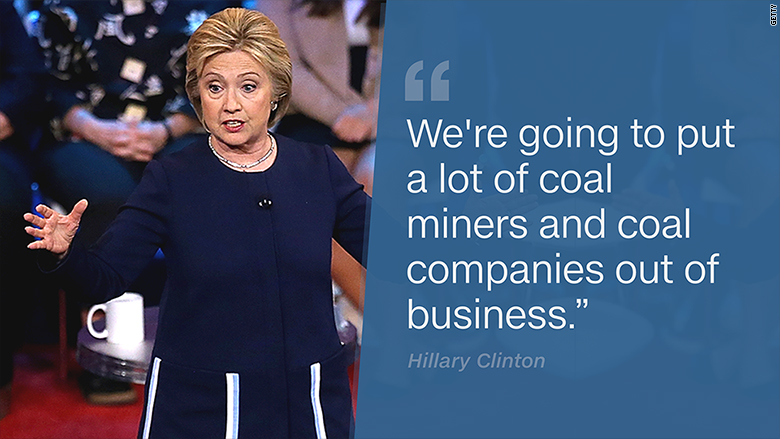
(Hillary wants to shut down coal- Source: Money.CNN)
The 2nd incident this week may provide an explanation.
Coal has become a political punching bag in recent years.
It’s not just talk, though. Coal mines have been shuttered at a seriously concerning rate. Take a look at the stats from the past few years:
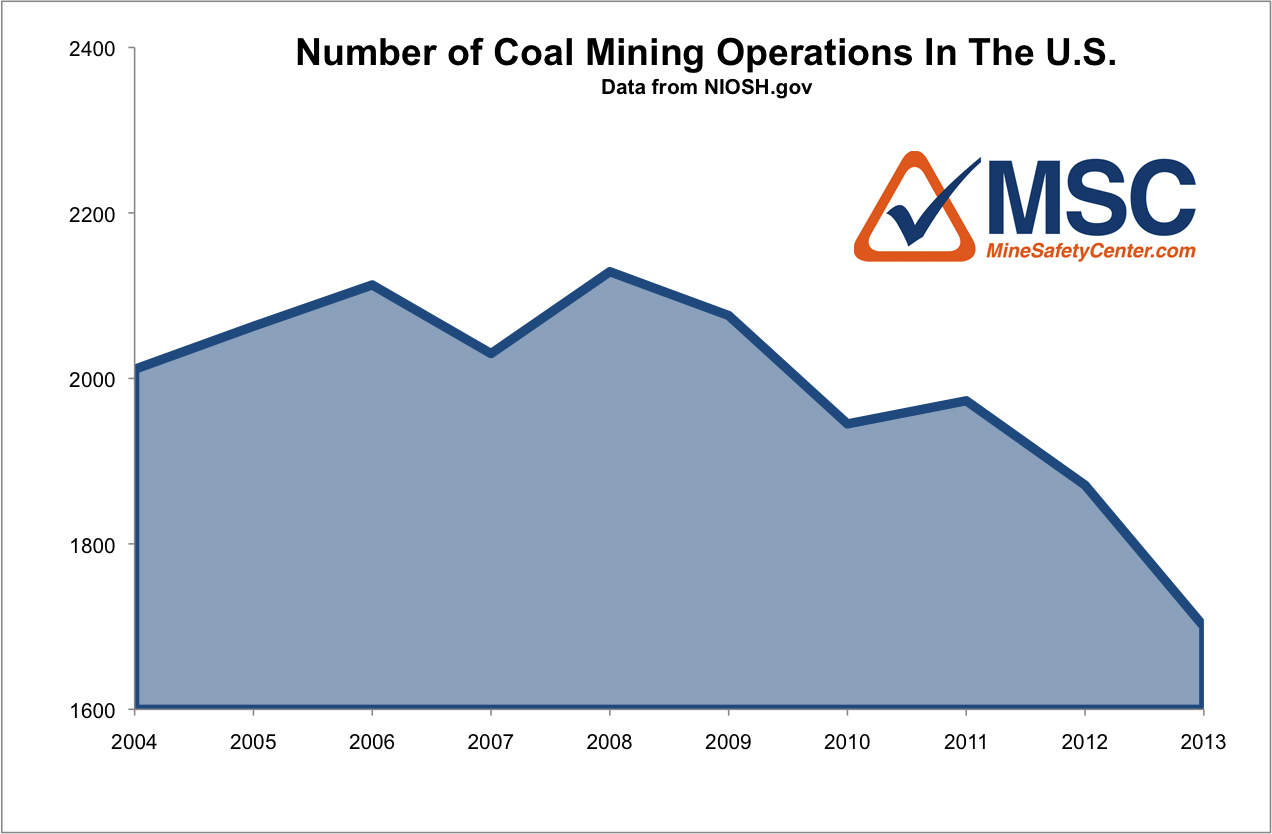
The number of coal mining operations in the US has fallen off a cliff.
That’s almost 200 operations per year closing their doors. And coal mining man hours are lower than they were during the great recession.
How does that affect the rest of the industry?
With fewer coal operations occupying their time those coal inspectors will have nothing to do. And do you think MSHA is going to fire any coal inspectors?
Not a chance.
Especially when MSHA continues to hire new inspectors (even if the quality and training of MSHA inspectors was declared to be a widespread and growing problem by an independent DOL internal review).
When coal mines close, MSHA will send inspectors elsewhere; the M/NM sector.
And it may have already begun.
MSHA Inspector On The Move
A coal inspector from Kentucky conducted an inspection in Washington State this week.
On its face that may seem innocuous but as Jim Sharpe has pointed out in the past, even MSHA’s seemingly small actions can cause enormous, seismic shifts. Why?
This transfer shows MSHA has already started shifting their resources from coal to M/NM. This may very well be the beginning of coal inspectors flooding Metal and Aggregate mining operations across the country.
These two incidents could combine for serious trouble in the near future. MSHA could simultaneously expand their jurisdiction and flood the M/NM mining sector with more inspectors with just these two actions.
And don’t expect an adjustment period. MSHA’s past actions show they will expect immediate compliance if they are able to get jurisdiction over commercial sales yards, recycling, concrete and asphalt operations.
That means every Commercial Sales yard, Recycling, Concrete and Asphalt operation will need to immediately be MSHA compliant. If (and more likely when) the companies aren’t prepared – they’ll be subject to the same large fines that mine operators and contractors already experience.
Are you and your colleagues ready if that happens?
This jurisdiction incident needs clarification before the horses leave the barn. As we’ve seen in the past, once MSHA sets a precedent it will be too late to go back. Fortunately, these issues haven’t been brought to the courts yet so there is no precedent…. yet.
You Can Make A Difference In 1 Minute – What Can You Do?
Get the word out. Email colleagues.
Share this article with colleagues on social media (using the buttons to the left).

You can contact any industry organizations where you’re a member. I know we’ll be speaking with our friends at CalCIMA and the Kentucky Crushed Stone Association to determine a course of action.
You can call MSHA themselves at 1-800-746-1553
Whatever you do, don’t let these incidents pass quietly. MSHA overreach and expansion is not inevitable. You can do your part.
Don’t Let Your Colleagues Get Blindsided By MSHA
Notes on the Q1 Quarterly MSHA Training Call
The Q1 Quarterly MSHA training call was held on April 27th, 2016 and contained quite a few bits of new information. Assistant Secretary of Labor for Mine Safety and Health, Joe Mains opened with an overview of 2015 and looking forward at 2016. Mr. Mains commented that the safest year ever in the U.S. for mine safety and health. He specifically pointed to the drop in silica and respirable dust levels every year since the black lung initiative began.
Mr. Mains also touted the new pattern of violations rules as a success. When MSHA established the new POV rules in 2010 there were 51 mines that were subject to POV status. In 2016 there was only 1 which didn’t even fully meet the criteria. (I would argue at least some of that drop was companies adjusting to the new rules, but I’ll get into my thoughts in a bit.)
MSHA Looking To Learn from 2015 Tactics
MSHA has “taken an aggressive all hands on deck approach” since August 3rd, 2015 when three miners tragically lost their lives in separate incidents, a first since 2002. Jeff Duncan, MSHA’s Director of Educational Policy and Development, went so far as to call it “aggressive actions on steroids” but was quick to point out the cooperation from industry associations and companies (More on that later).
MSHA officials declared that last year is the template and road map for the future. Coal will now take up best practices discovered on M/NM side. What might that look like?
MSHA Initiatives and Enforcement in 2016
During the call there were repeated statements that MSHA will continue and potentially increase their heightened presence at sites across the country. That includes “more boots on the ground and more focus on enforcement.” We will also see the increase in impact inspections continue.
MSHA indicated they plan to:
- Put more focus on outreach which officials say keeps safety awareness higher.
- Continue talking with industry, and encouraging industry officials focus on learning the lessons from recent serious injuries and fatalities. Especially focusing on an increased use of best practices in pre-op exams.”
- Release Safety Alerts monthly to “keep industry the focused on safety.”
- Conduct more walk and talks on coal side.
- Encourage companies to “look hard at conditions that have cost miner’s lives.” pre-shift examinations. Curb injuries with walk and talks.
Quarterly MSHA Training Call Signals Continued Enforcement
Over the past year MSHA has consistently extended an olive branch to industry associations and leaders. They are involving the mining industry in their safety initiatives through partnerships and meetings, more than ever before. That may be the carrot in MSHA’s carrot and stick approach.
But MSHA officials are also on site more than before. More walk and talks, inspections and meetings.
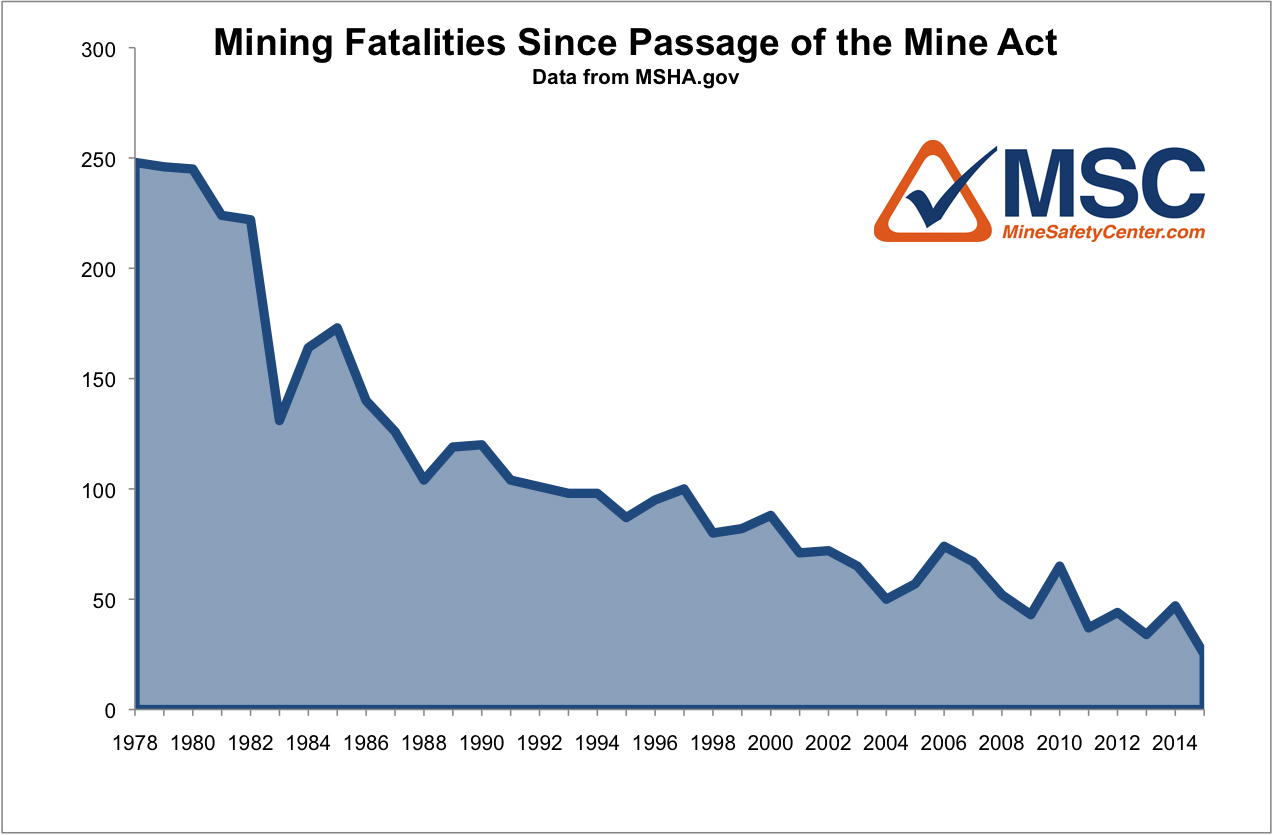
MSHA sounds convinced their increased involvement has been the crucial factor in improving mine safety. Maybe they’re right when you take the long view. Fatalities and injuries have trended steadily down since the Mine act was passed in 1977.
But they only have 6 months of data to back up their conclusions on these latest, drastic initiatives. It remains to be seen whether it’s a wise choice to base what sounds like an overhaul of the administration’s operating procedures with so little data.
I’m rooting for better industry and MSHA cooperation. The goal of both groups is a safe and productive work force. I’m still leery of Joe Mains’ history of overzealous citations and fines.
What does this mean for you? Get ready to see a lot of your friendly, neighborhood MSHA inspector and other officials this year. Focus on the safety basics and you should be fine.
Let’s just hope MSHA doesn’t turn it’s olive branch into a club over the next few months.
Sign up to get MSHA updates and tips like this sent right to your inbox. Don’t get blindsided by MSHA, stay informed.

You can find the quarterly MSHA training call notes on MSHA.gov. The call’s audio recording will be released later.
The Mining Industry In The U.S. Just Concluded Its Safest Year Ever
Preliminary statistics released by MSHA the afternoon of Thursday, April 7 show that 2015 was the safest year ever in the U.S. mining industry. This closely mirrors the fatality analysis I conducted earlier this year. Mining deaths are down across the board and have been trending that way for decades.
“In 2015, 28 miners died in mining accidents, down from 45 in 2014,” says Amy Louviere, MSHA’s media contact, in the press release.
But the announcement also released more granular data for 2015 than was previously available. This data allows an in depth analysis of the injury rate and total number of injuries. Ms. Louviere continued:
These rates are calculated based on hours of miners’ exposure, a relative measure taking into account recent employment changes in the mining market. The fatal injury rate, expressed as reported injuries per 200,000 hours worked, was the lowest in mining history for all mining at 0.0096.
Take a look at the progress on this key statistic over the last few years:
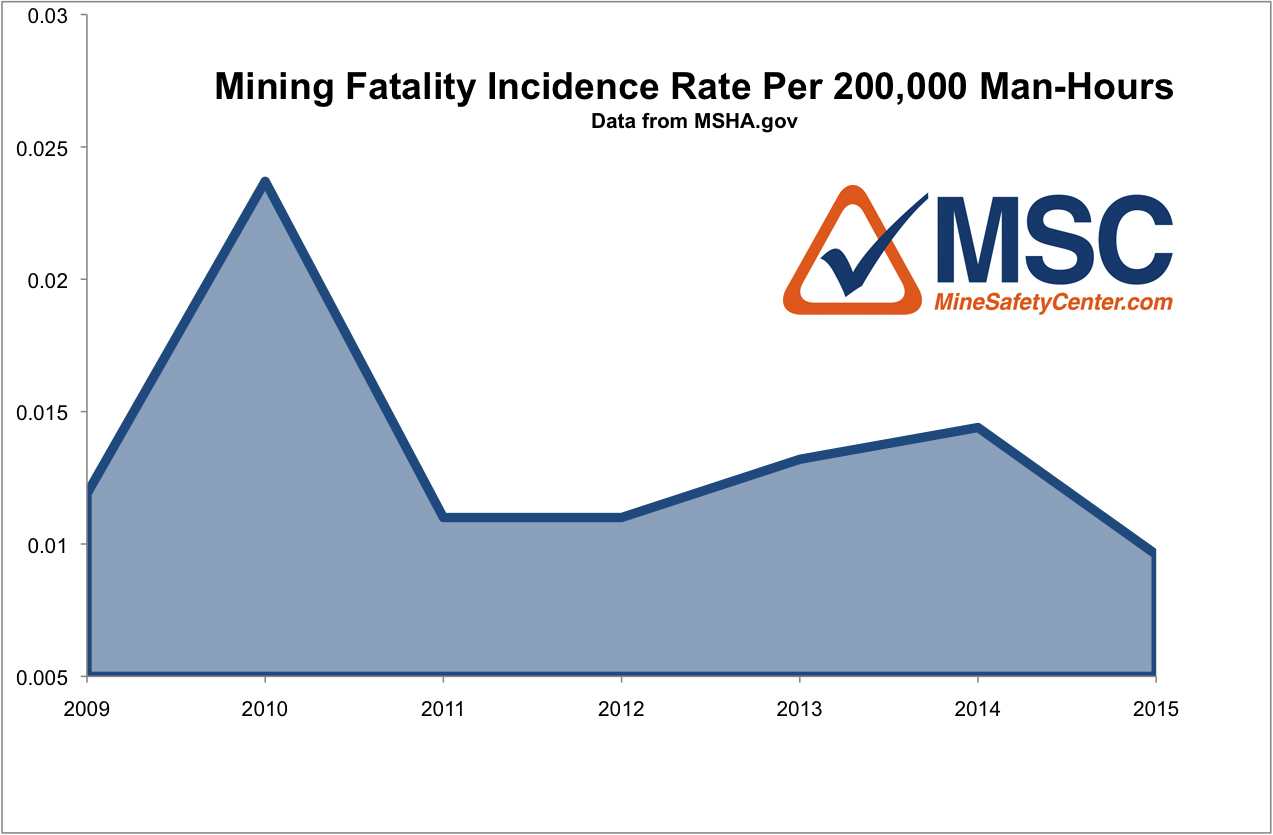
Mining Industry Injuries Down
But even more impressively, the mining injury incidence rate (again per 200,000 man-hours) dropped significantly. According to Ms. Louviere, “the all-injury rate – reported by mine operators – also dropped to a new low in 2015 at 2.28.”
Not only are less injuries leading to fatalities, there were also less injuries. Period.
Injuries and fatalities lowest ever in mining industry. Even when adjusted for man-hours worked.

Look at the trend over the last few years. This is outstanding progress:
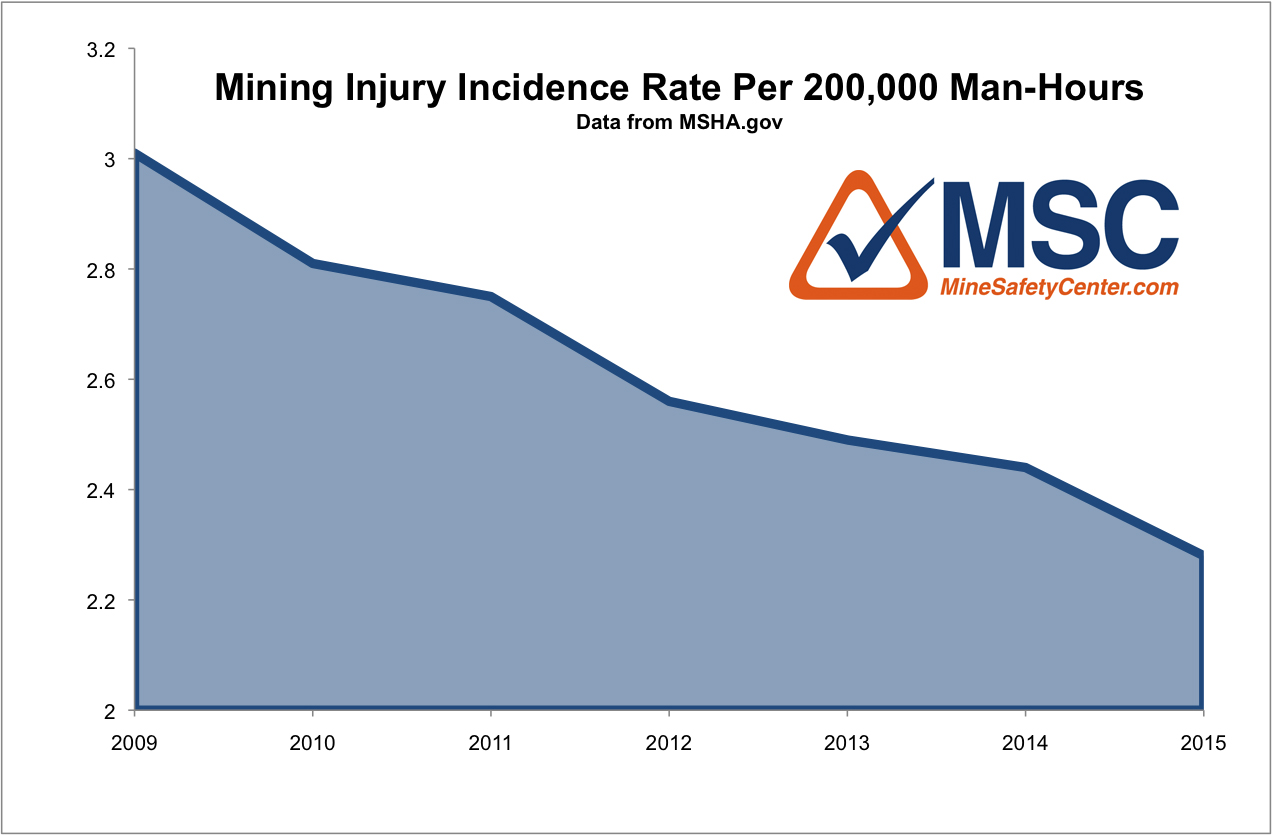
The injury incidence rate is down 25% since 2009.
What does the injury rate translate to in actual numbers? After consulting this very cool incidence rate calculator (and brushing up on a little Algebra) I was able to figure out the total number of hours worked and injuries.
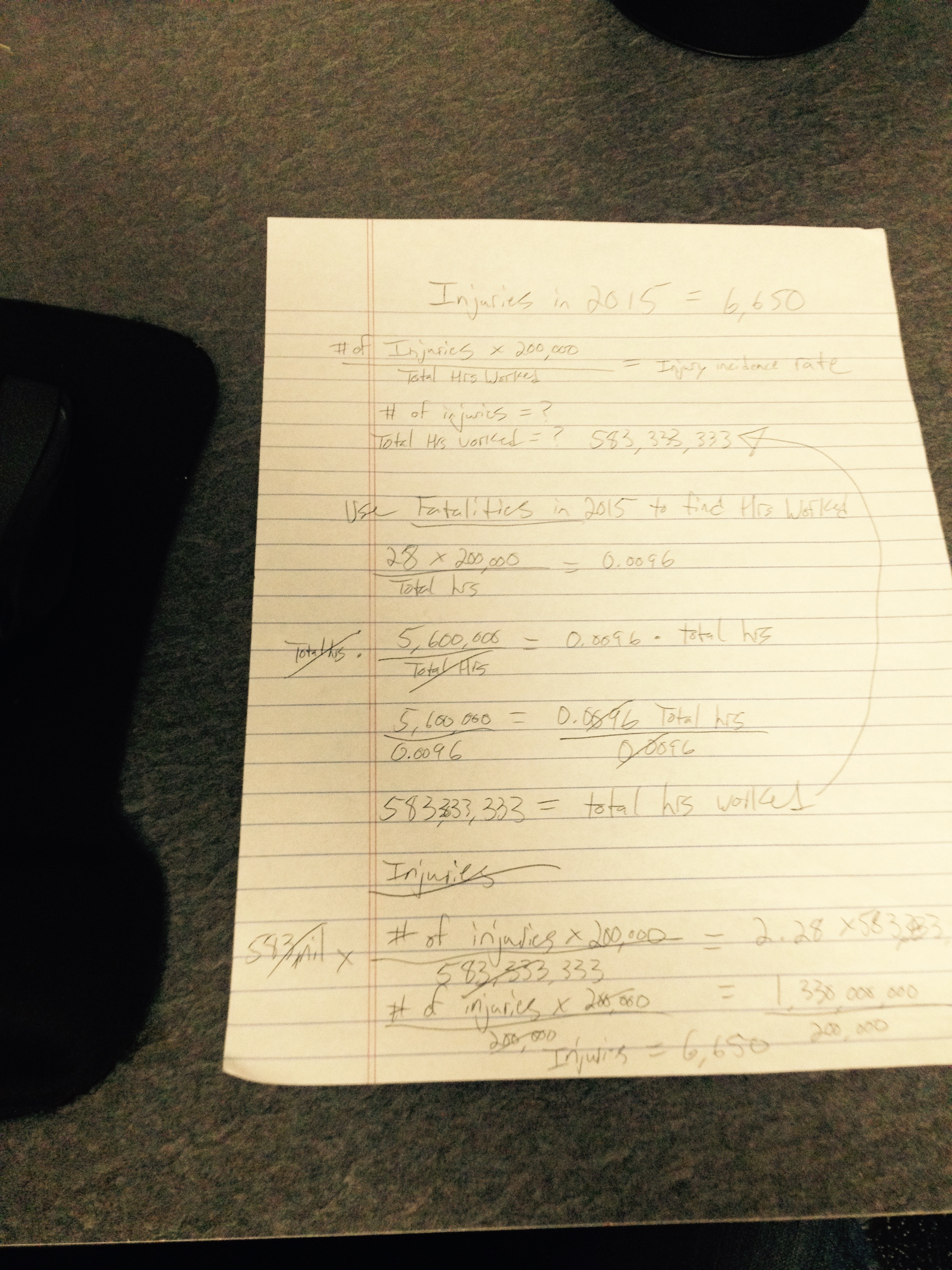
The mining industry combined for a total of 583.3 million man-hours in 2015. During that time, 6,650 total injuries occurred. Again, this number of injuries is a significant drop off. So while man-hours were down 7% from 2014 to 2015, the number of injuries dropped an impressive 13%.
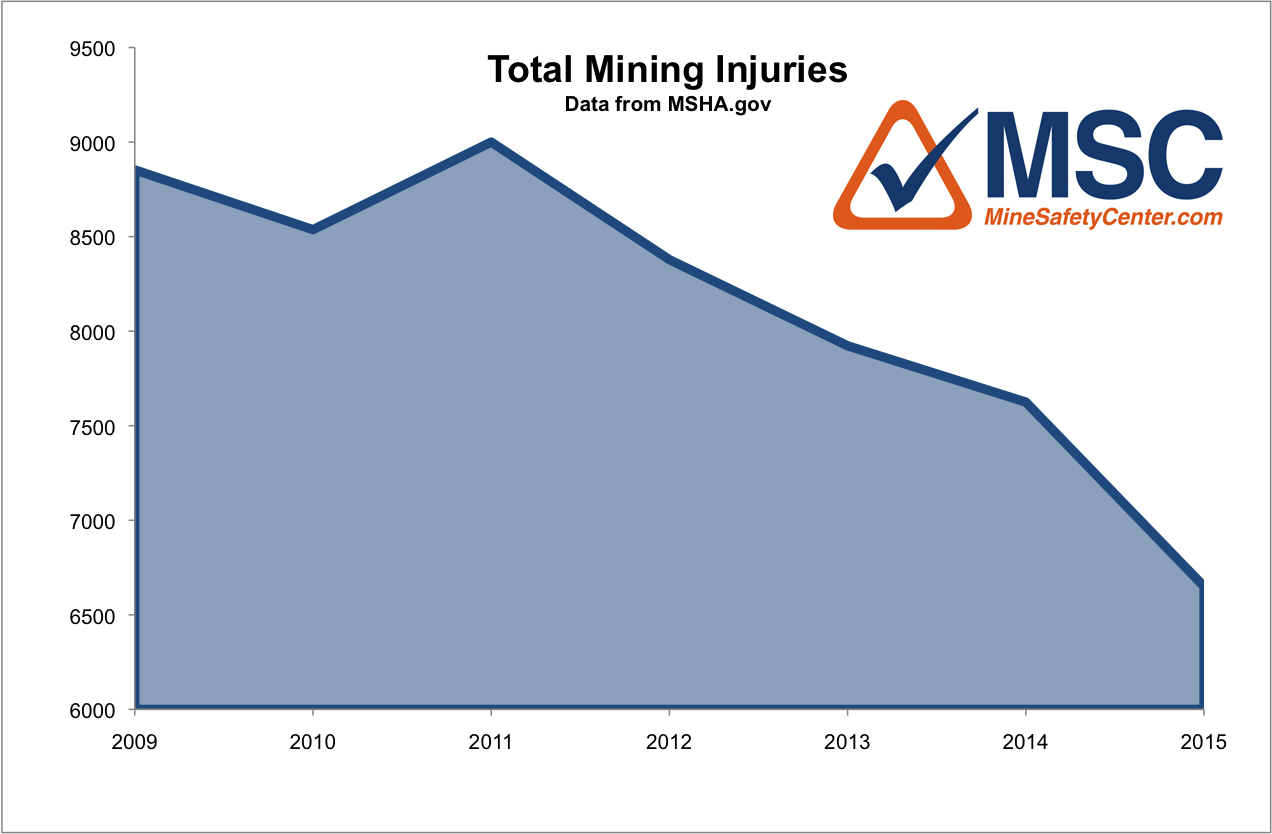
Mining Industry Contractor Safety
Contractor fatalities were also down. In 2015, 8 contractors lost their lives compared to 12 in 2014. Obviously, a single loss of life is too many but a downward trend is great news. Unfortunately, MSHA doesn’t release the Total Injury Rate for Contractors.
The spike in overall fatalities and particularly contractors caused MSHA to declare a surge in the M/NM sector. These trends are promising but don’t look for MSHA to pull back their enforcement any time this year.
“The progress we made in 2015 is good news for miners and the mining industry. It is the result of intensive efforts by MSHA and its stakeholders that have led to mine site compliance improvements, a reduction of chronic violators, historic low levels of respirable coal dust and silica, and a record low number of mining deaths,” said Joe Main, assistant Secretary of Labor for Mine Safety and Health.
In other words, expect MSHA to continue their recent uptick in enforcement and inspections across the mining industry.
MSHA Fines Down
There is also another surprising piece of information in the article that could potentially be overlooked. The amount of MSHA fines is trending down. MSHA doesn’t count contested fines in these statistics which leads to artificially low numbers (MSHA reported $62.3 million collected for 2015, a giant drop from the $95 million average in 2013 and 2014.) So as cases wrap up, the total for 2015 will increase. But even if we throw out the artificially low 2015 numbers, the trend is still there. Even with this drop, MSHA inspectors still have a few tricks they like to try.
The most MSHA fines collected in a year occurred in 2010 with $162.8 million dollars. But since 2012, the trend has been decidedly downward.
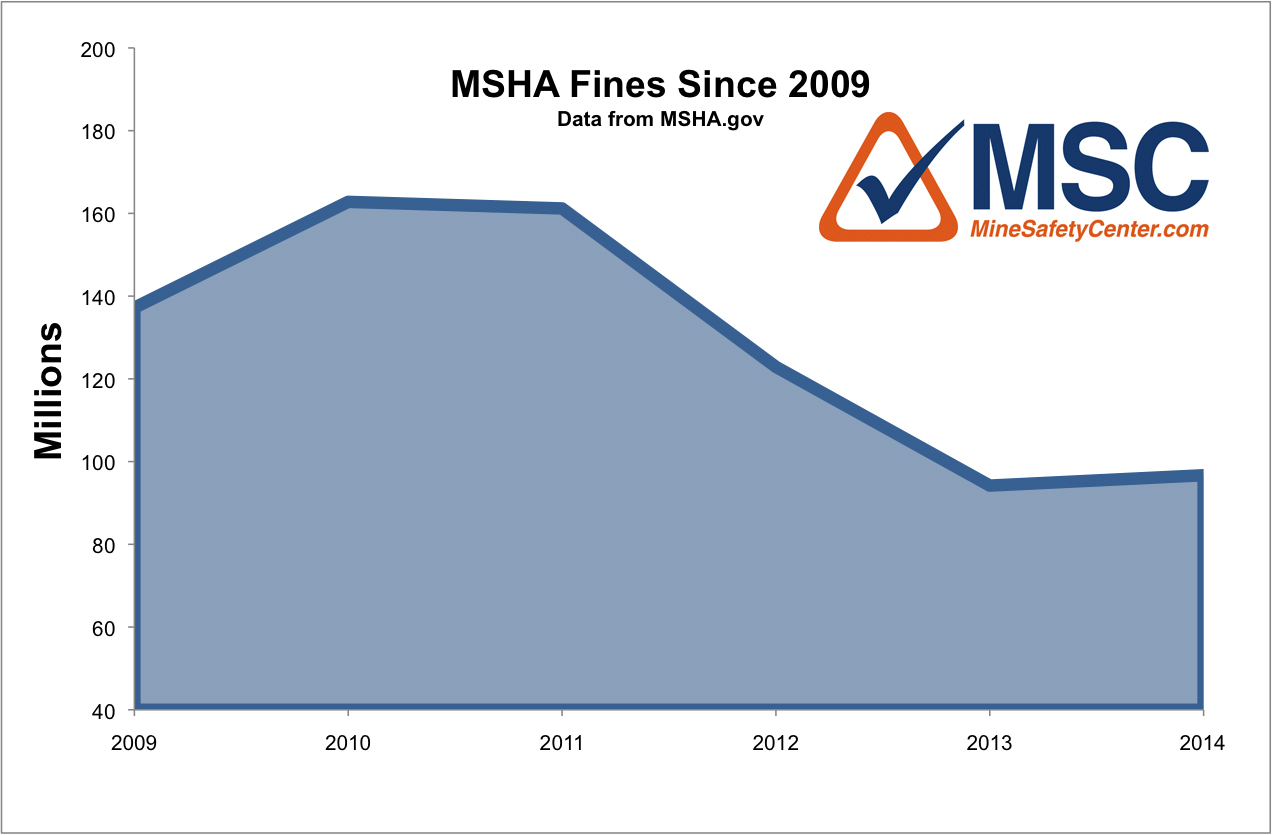
This is good news for an industry that has had a very hard year. Safer mines and fewer fines? That’s something the mining industry and MSHA can both get behind.
Let’s work towards continuing both trends in 2016.
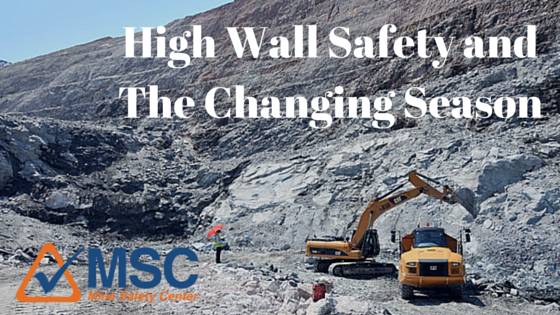
It may not feel like it where you are, but spring is right around the corner. Many operations are about to begin the preparations to start up operations after a long winter. But as the season changes from winter to spring, there may be a hidden danger lurking on your site. High walls become much more unstable and prone to collapse during the spring and fall. High wall safety in surface mining is an essential topic for everyone on a mine this time of year.
What is happening during the fall and spring causing the large increase in high wall and stockpile failures? There are four main causes according to mine safety expert, Kim Redding.
Added Weight
As snow melts and spring rains begin, huge amounts of moisture are added to the ground. This adds weight to the material making the gravitational pull greater and much more likely for the material to go to angle of repose in spectacular fashion.
Changing Temperatures
With spring comes rapidly changing temperatures. Moisture in the ground may go from ice to water and back to ice throughout the course of one day. As our science teachers would remind us, water expands 10% when it changes phases into ice. This expanding and contracting within the ground (and your high wall or stock piles) loosens material.
Erosion
As ice melts, the run off cuts away at materials and can very quickly take a high wall or stock pile from stable to failure. Flowing water is considered a lubricant for dirt and rock. You can see a great example of this at the Grand Canyon.

Hydraulic Pressure
When the ground is wet, gravity pulls water down to the water table. Water can cut and erode material as it travels making the ground more unstable.
If you work in an area with high concentrations of clay you need to be extra cautious. Clay may be one of the most dangerous materials we deal with in mining. Why? Clay can make a high wall stand much longer than all other materials. When a high wall with clay fails, it doesn’t come down in small slides like hard rock. Clay fails catastrophically.
How can you stay safe?
A thorough work place exam every day, at every task is an absolute necessity. Not only is a workplace exam required by law, it also gives you an opportunity to see any changing conditions of the high wall. Specifically look for cracking, sloughing and other indications that the material may fail. MSHA poster “Inspect the top and bottom of the high wall for cracking, spalling, sloughage, loose ground, and large rocks that could be hazardous.
If you do see these signs, tell your supervisor immediately. Ensure loose material is scaled prior to performing work. To safely scale using the shovel, maintain the high wall height within the reach of the bucket.
Do not work under loose material for any reason.
Pay special attention when working in the corners of box cuts.
Do not dig into the toe of a high wall.
Increase the number of benches at each high wall to catch falling material.
Use CB radios to keep equipment operators informed of high wall conditions.
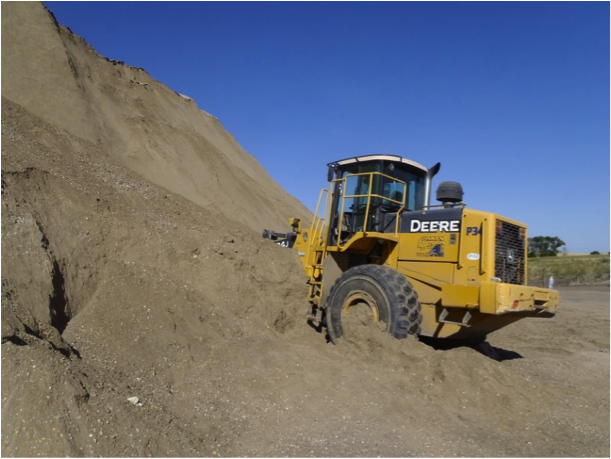
MSHA Rules To Live By – High Wall Safety In Surface Mining
There are also several applicable points from the MSHA Rules To Live By initiative.
- Never place yourself between a high-wall or stockpile and machinery. If a wall fails you will have a lesser chance of survival because if a machine is blocking your escape.
- Material only needs to come to the diaphragm for a person to suffocate.
- Always run machines facing the high wall. This allows you to watch for indications that the high wall is about to fail as you are completing your duties.
- Finally, never turn your back on the high wall. You need to be able to watch the wall at all times for increases in falling material that may indicate a failure.
Taking these simple steps and a little bit of time each shift can dramatically increase high wall safety in surface mining. Always be alert when you’re anywhere near a high wall or stock pile. It could be the difference between life and death.
Want more mine safety and compliance articles? Sign up for our free updates.

How To Avoid The 5 Most Cited MSHA Standards of 2015
Ever finish a Mine Safety and Health Administration (MSHA) inspection with your head spinning? You feel confident when the inspector arrives. Then the notepad comes out. Did the experience leave you with questions? Saying to yourself “How did we get hit for those MSHA standards? We run a good operation. How did we get so many fines?”
Obviously, MSHA citations are costly. But on top of the financial penalty, there are more subtle costs. Unlike money spent on training or workplace safety improvements that can prevent citations, MSHA fines aren’t tax deductible. MSHA citations also cost your company man-hours through additional inspections and time spent contesting the tickets. Finally, S&S citations affect your POV status, which can lead to even more fines if MSHA determines you have a Pattern of Violations.
Knowing where MSHA inspectors are looking, what they’re looking for and what they’re citing is valuable information. This information can give your team a path to go above and beyond your standard work safety and inspection procedures in targeted, high value areas.
That’s why I took a deep dive in the data provided on MSHA.gov. Let’s examine which Metal Non-Metal (M/NM) MSHA standards were cited most in 2015 and compare them to 2014. We can begin to see where MSHA is devoting their time and resources.
Spoiler: It doesn’t always match their many enforcement announcements. I know, you’re shocked.
The Most Cited M/NM MSHA Standards of 2015
MSHA citations at M/NM locations were essentially flat from 2014 to 2015. In 2014 there were 60,155 M/NM MSHA citations and 60,075 in 2015, a decrease of 0.01%. What were the top 5 most cited MSHA standards in 2015?
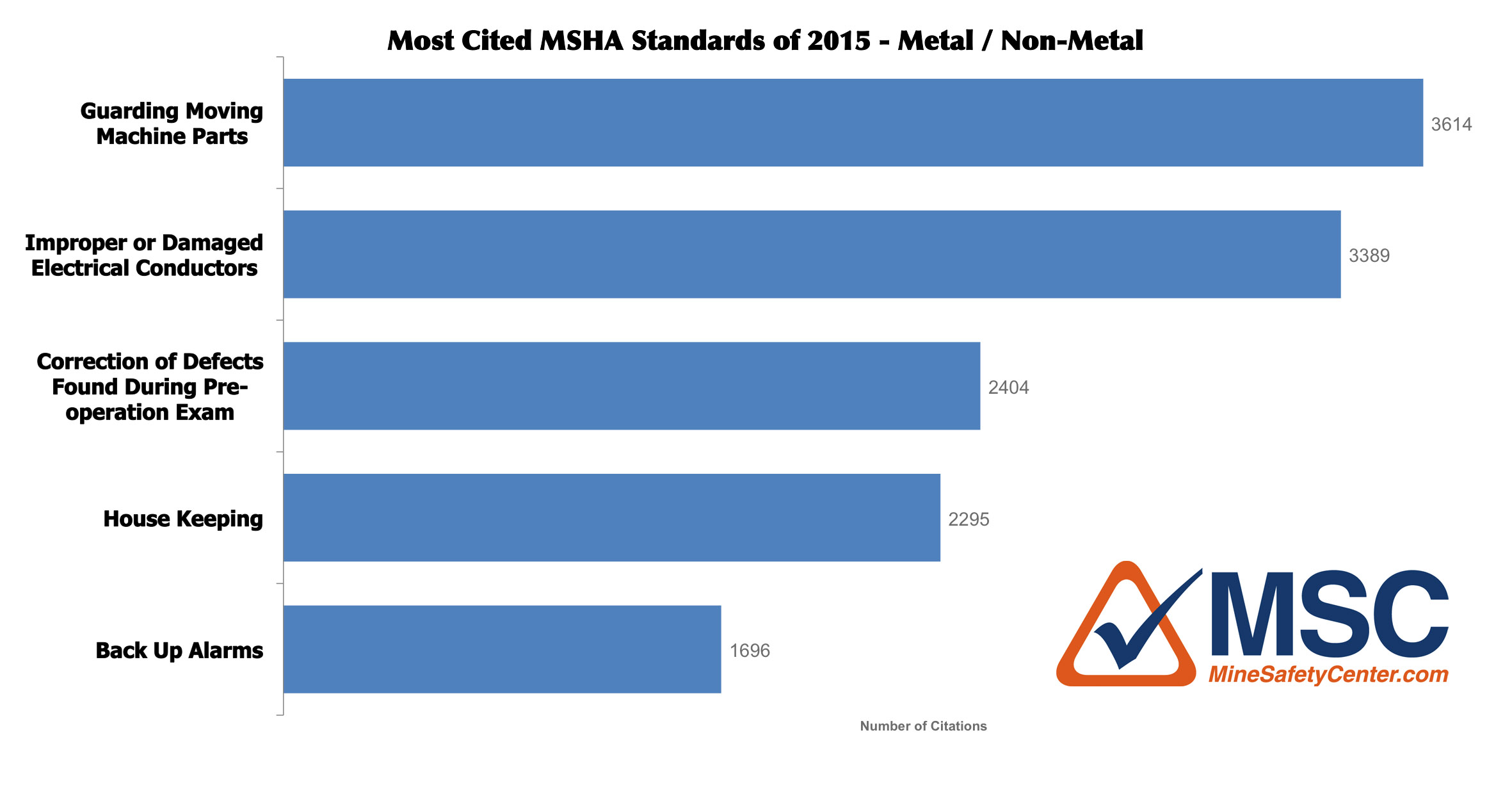
As you can see, Guarding and Damaged Electrical Conductors are far in front of the pack. That’s even more apparent when we look at the Top 15 standards in the next graph.
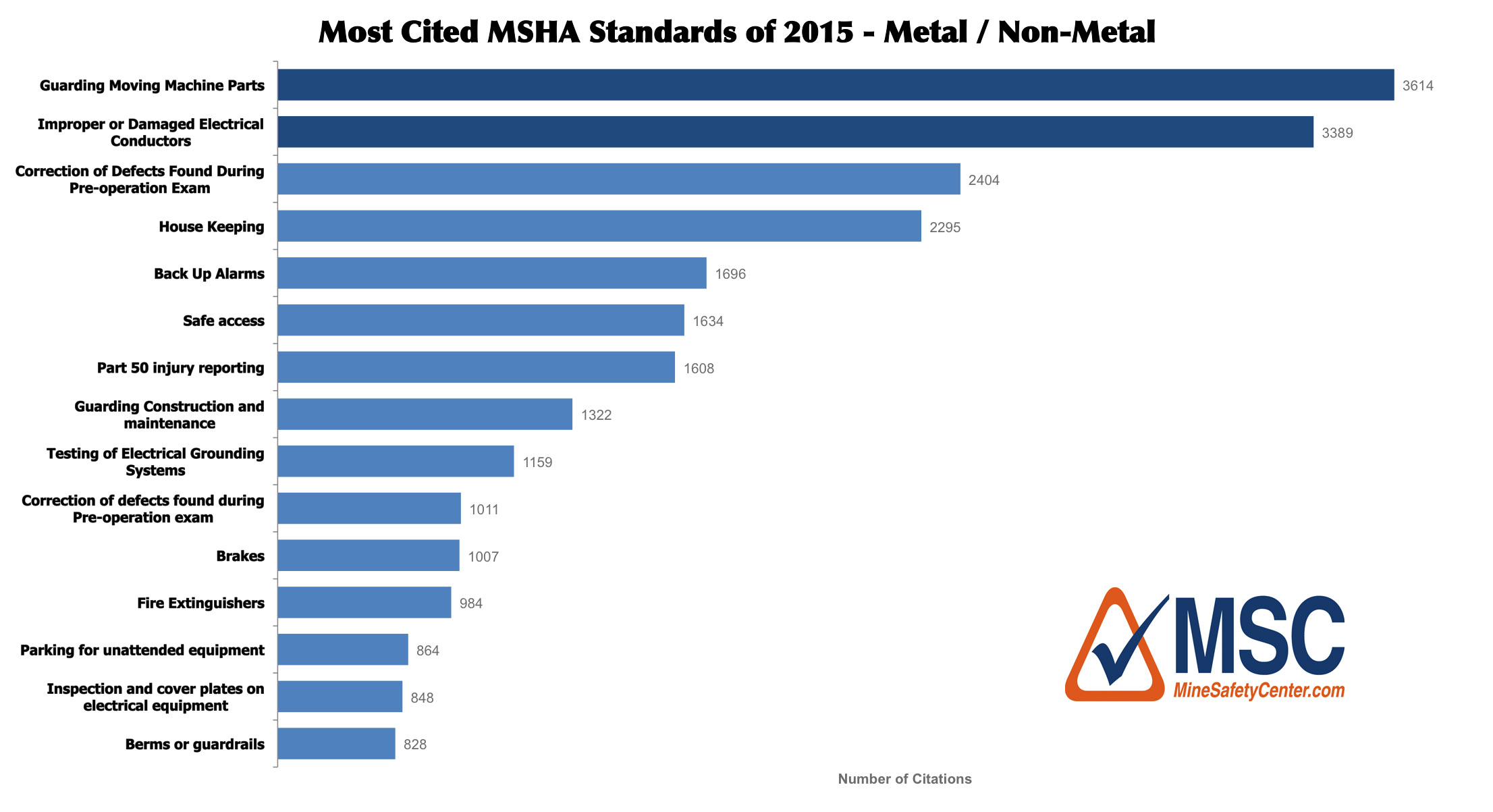
The 5 most cited MSHA Standards accounted for over 23% of all M/NM violations in 2015 and 22.8% in 2014. The 2 most cited MSHA standards accounted for 12% of all tickets written in 2015, more numbers 10 through 15 combined (11%). Focusing resources to improve your compliance is an efficient way to reduce your MSHA fine exposure.
How Do The Most Cited MSHA Standards of 2015 Compare to 2014?
There was only one change in the top 5 from 2014 to 2015. Part 50 injury reporting was replaced by house keeping in 2015. The number of Part 50 citations decreasing is an interesting development considering MSHA announced an increased emphasis on Part 50 reporting.
[infogram id=”msha_fines_2014_v_2015″ prefix=”yZk”]
How Can You Reduce Your Risk of Fines for These MSHA Standards? Let’s go through the standards one by one.
5. Back Up Alarms – MSHA standard 56.14132(a)
Manually operated horns or other audible warning devices provided on self-propelled mobile equipment as a safety feature shall be maintained in functional condition.
MSHA regulations require back up alarms are functional and must “be heard above the surrounding noise.” That phrase is very subjective and open to interpretation by the inspector. What one inspector would let go another may not. This is where most citations for this MSHA standard are written.
If a back up alarm isn’t operational, by law you can have a spotter as a substitute and still use that vehicle. But the spotter must be with the vehicle the whole time it’s in use. Not a very practical option and certainly not an efficient use of resources.
Back up alarms can cause complacency. We hear them all day long. It can become just another noise in the background. For example in 2004, 14 people were killed in Washington State backing accidents. The back up alarm was fully functional in every incident. The situation was so serious the state legislature passed an emergency law requiring all trucks dumping on construction sites to have spotters.
“The CDL test advocates that over the road trucks should try to minimize backing up, because of blind spots, and potential to hit something or someone,” said former MSHA inspector and Mine Health & Safety consultant Kim Redding. “The best practice to prevent backing incidents and citations is to set up your whole operation so there’s little or no need to back up. Obviously this is impractical or prohibitively expensive for some.”
He continued, “If this option isn’t available, make the danger of backing top of mind at your company. Backing is one of the largest causes of injuries and damaged equipment. Everyone on your site should know and understand they shouldn’t back up unless absolutely necessary.”
4. House Keeping – MSHA standard 56.20003(a)
Workplaces, passageways, storerooms, and service rooms shall be kept clean and orderly.
This is a very broad standard. You can get a ticket for a disorganized workshop, a messy vehicle cab, even a dirty microwave. Spilled materials are commonly cited under 56.20003(a). Any dust or silica build up can be seen as a trip hazard.
“When I was an MSHA inspector I saw poor housekeeping as a red flag,” said Kim Redding. “If you can’t do the simple things like cleaning up your work place, it’s more likely the big things won’t be done either.”
A clean work environment makes your company safer and more productive. Potential hazards easier for your company to spot and fix immediately when an area is clean and organized. As Jamie Ross of Mining Man puts it “don’t leave a trap for somebody else.” As you walk around your site, take a look for areas that could be tidied up.
Putting an emphasis on house keeping is a simple way to quickly make a site safer and more MSHA compliant. Employees don’t waste time looking for tools and equipment in an orderly shop.
3. Timely Correction of Defects Found in Pre-Operation Exam – MSHA standard 56.14100(b)
Defects on any equipment, machinery, and tools that affect workplace safety shall be corrected in a timely manner to prevent the creation of a hazard to persons.
Complying with 56.14100(b) should be straightforward but MSHA has a curveball. Even if you fix a defect you can still get a citation. How? As top mining attorney Mike Heenan said in a great interview with Pit & Quarry, “too often, operators only write down what the problem was, so you have a list of problems without a list of solutions. Maybe the operator has fixed those problems listed, but they might not write that down. You have to finish up the story in writing.” In this situation, some inspectors will write a citation, others may not. It’s up to your operation to take away the opportunity for a ticket.
2. Improper or Damaged Electrical Conductors – MSHA standard 56.12004
Electrical conductors shall be of a sufficient size and current-carrying capacity to ensure that a rise in temperature resulting from normal operations will not damage the insulating materials. Electrical conductors exposed to mechanical damage shall be protected.
A thorough workplace exam is essential to compliance with 56.12004. Many conductors are exposed to weather, impact, vibration, abrasion, and heat. Inspection of electrical conductors must always be a part of workplace examinations. Schedule inspections on a regular basis for areas of your operation that are less frequently traveled.
If anyone discovers a violation it must be dealt with right away. Many times a health and safety hazard can become part of the workplace if it’s noticed but left uncorrected. It’s human nature. That’s how hazards don’t get fixed and become violations.
1. Guarding Moving Machine Parts – MSHA standard 56.14107(a)
Moving machine parts shall be guarded to protect persons from contacting gears, sprockets, chains, drive, head, tail, and take-up pulleys, flywheels, couplings, shafts, fan blades, and similar moving parts that can cause injury.
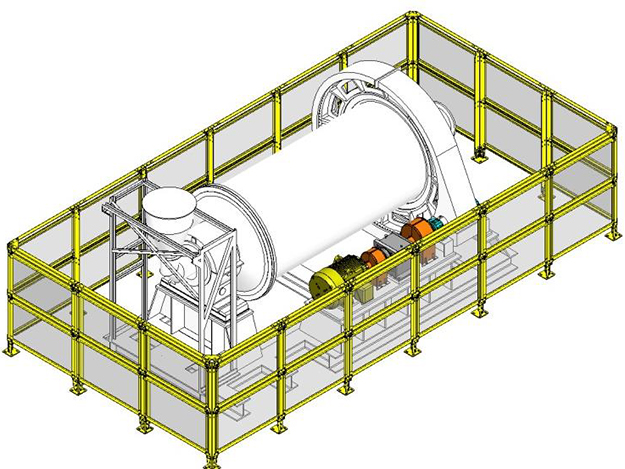
Guarding is by far the most cited MSHA standard and it’s been that way every year for the past decade. Don’t expect that to change in 2016, especially since the first fatality this year was a person killed when they got caught in a conveyor.
There is a clear history of inconsistent enforcement of MSHA regulations. Guarding is particularly hit or miss because the standard is extremely subjective. One inspector may cite you for an area that another inspector has approved for years.
In his interview with Pit & Quarry, Mike Heenan remarked, “It’s amazing to me in all these years that machine guards continue to be up there with other violations. It’s been my contention for a long time that MSHA should spend less time finding citations and instead finding more important things in Rules to Live By.”
“Many times I’ll tell operators their guarding isn’t MSHA compliant,” Kim explains “and they say ‘There’s no way, these are factory guards!’ Just because the guards came from the factory doesn’t mean they’re MSHA compliant. The factory builds on spec. If you don’t specify you want something guarded, they won’t do it. They’re a business that needs to keep their margins up just like you. On top of that, MSHA won’t cite the manufacturer for the violation. It’s your job as a mine operator to request MSHA compliant guarding.”
The best way to protect workers and reduce your risk of citations is to guard all moving machine parts. That includes bolt heads, key ways, couplers, everything. Box in every moving part, everything, so no one can touch, get near a moving part or in a restricted area. MSHA inspectors can and will contort their bodies to show there is a “possibility” someone could be injured.
In the most basic terms, the potential for an MSHA citation exists if an adult sized toddler could touch anything dangerous.
Key Takeaways – Health and Safety at Work
There is a definite trend in the most cited MSHA standards. Nearly all of the rules are open to interpretation. Every MSHA inspector is different and you may have 2 inspectors interpret the rules in completely different ways. You can either leave it to the luck of the draw or be proactive and engineer your operation so there’s no opportunity for an inspector to cite you. But you have to make that decision for yourself and your company.
Because they’re cited so much more often, you can get the most return on your investment by aggressively focusing your compliance efforts on the top 5 MSHA standards above.
Sign up for more MSHA tips and updates.
MSHA Safety Hazard Alert
Late yesterday afternoon Neal Merrifield distributed yet another MSHA Safety Hazard Alert. He begins:
Since 2008, six persons have died at metal and nonmetal mines in accidents involving large diameter plastic pipe. Two delivery truck drivers were killed while their flatbed trucks were being unloaded at the mine. In both cases, an unsecured section of pipe rolled from atop the truck’s load of pipe, fell and struck the driver as he stood nearby. Two pipe crew supervisors, one a contractor, died while connecting sections of pipe using excavators and lifting straps to support and position the pipes. One died when the pipe slipped out of the strap and struck him; the other was killed when the pipe sprung out of the positioning cradle and struck him. A pipe foreman and a contract laborer were killed when they were struck or crushed by the pipe while assisting excavators re-position long sections of pipe using lifting straps.
Again, MSHA mentions their increased use of walk and talks, however this time without a veiled threat:
MSHA plans again this month to continue walk and talks at mine sites and enlist the assistance of mines, miners and mining industry groups in the effort to raise safety consciousness, stay safety-vigilant 24/7 and send miners home every day at the end of their shift.
That’s a sentiment we can all get behind. Though there were too many tragic deaths last year, 2015 was overall the safest year ever for the mining industry.
The alert also included some practical information.
MSHA standards require that materials not be stacked in a manner that creates a fall-of-material hazard, that taglines be attached to loads that may require guidance or steadying while suspended, and that hitches and that slings used to hoist materials be suitable for the particular material handled.
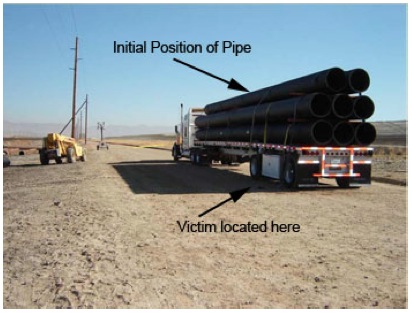
Our Recommended Best Practices – Lifting and Handling Plastic Pipes
Here are some best practices for lifting large objects of any kind with a few specific to plastic pipes:
- Task train all persons prior to performing work.
- Secure loads on trucks, forklifts and cranes.
- Establish and discuss safe procedures before beginning work. Identify and control all hazards with the work to be performed along with the methods to properly protect persons.
- Ground personnel should be highly visible. Unauthorized persons should be kept clear of the area. Examine work areas during the shift for hazards that may be created as a result of the work being performed.
- Verify slings are in good condition and securely attached before beginning a lift.
- Stand clear of items of massive weights having the potential of becoming off-balanced while being loaded or unloaded.
- Use taglines of sufficient length to adequately protect persons.
- Keep pipes as straight as feasible to avoid any spring-like motion.
- Evaluate the stability of the material before unfastening a load. Pay particular attention to loads that may have shifted or become unstable during transport.
- To prevent pipes from falling when the load is unfastened, secondary supports (such as side stakes) may need to be installed before the load.
- Unload materials on level ground and in a safe, controlled manner.
- Monitor personnel routinely to determine that safe work procedures are followed.
For more detailed information you can consult this post from North American Pipe Co.
A number of MSHA safety hazard alerts have been issued to open 2016. Now is the perfect time to conduct a thorough examination of your operation and equipment. Ensure everything is MSHA compliant and in working order before operations ramp up in the spring.
Never miss an MSHA enforcement initiative again. Sign up to have MSHA and industry updates sent right to your inbox.
MSHA Safety Enforcement Alert Announces Vague Initiative
After last week’s serious incident, today brings another MSHA safety enforcement announcement and boy is it broad. MSHA’s M/NM Administrator Neal Merrifield begins the announcement:
Since 2011, 16 metal and nonmetal miners have died in accidents involving machinery and non-haulage mobile and quarry equipment, and many more have been seriously injured or disabled. Of the 16 persons fatally injured, six were supervisors and three were contractors. Seven miners died when they were struck by the equipment they or a co-worker were operating, four miners drowned when their equipment ran into or overturned into water, and five more died when they were caught in crushers, on drill steel or between reciprocating machinery. The equipment involved represented a wide variety of mining equipment: drills, dozers, excavators, graders, dredges and crushers… MSHA plans again this month to continue walk and talks at mine sites and again enlist the partnership of mines, miners and mining industry groups in the effort to raise safety consciousness.
I’ll repeat that, “drills, dozers, excavators, graders, dredges, and crushers.” MSHA is essentially announcing close inspections of all machinery and equipment used in the process of mining. Their stated purpose is admirable as always, but you have to consider MSHA’s previous methods of “raising awareness.” Recent history tells us it will likely involve increased inspections, citations, and fines.
This is the 5th announcement of increased MSHA safety enforcement in just the past few months. MSHA has announced an enforcement “surge” on M/NM mines which includes transferring inspectors from coal to M/NM, an emphasis on confined spaces and Lock Out, Tag Out, Try Out procedures, and Part 50 injury reporting. They have also been given funding to hire more MSHA inspectors.
Merrifield goes on to offer some best practices:
MSHA standards require operators to maintain control of mobile equipment while it is in motion, and to operate at speeds consistent with conditions of mine roadways, tracks, grades, clearance, visibility and traffic. When mobile equipment is not in motion, it must be stopped in a safe location and when not attended, parked in a manner that prevents it from moving and becoming a hazard to the operator or other miners. In addition, mine supervisors and equipment operators need to continuously monitor and maintain roadways and berms and operate mobile equipment in a controlled, safe manner. When operating excavators, position the as far from the water’s edge as feasible on firm, stable ground. Don’t traverse unstable ground above a highwall and stay off and away from over-steepened stockpiles until they can be made safe.
You can download today’s Machinery and Equipment Hazards Alert here.
Considering the number of recent MSHA safety enforcement alerts, 2016 is going to be a very busy year for mine managers, safety professionals, and mine contractors. Prepare your company for MSHA compliance in 2016. MSC expert and Ex-MSHA inspector, Kim Redding, has a free MSHA compliance video series. Learn MSHA tips from a former MSHA inspector.

MSHA Safety Alert – Haul Truck Incident and Best Practices
This morning brought another MSHA safety alert involving a serious accident. The incident happened at a Surface Limestone operation where “a miner was operating an empty articulating haul truck. The driver lost control on a downhill grade and overturned. He was hospitalized with serious injuries but survived, likely because he was wearing his seat belt.” The injured driver will be in our thoughts today.
MSHA’s best practices to prevent future haul truck injuries include:
- Always wear a seat belt when operating mobile equipment.
- Task train mobile equipment operators adequately and ensure each operator can demonstrate proficiency in all phases of mobile equipment operation before performing work.
- Conduct adequate pre-operational checks and correct any defects affecting safety in a timely manner prior to operating mobile equipment.
- Maintain control of self-propelled mobile equipment while it is in motion.
- Post safe speed limits for the mine roads and remind mobile equipment operators to reduce speed when weather conditions change.
You can download the alert pdf here.
MSHA has been very active recently. In just the past few months they have announced an enforcement “surge” on M/NM mines, an emphasis on confined spaces and Lock Out, Tag Out, Try Out procedures, and Part 50 injury reporting. MSHA safety alerts have also been issued with increasing regularity. 2016 is shaping up to be a busy year.
The best practices in today’s MSHA safety alert don’t just apply to haul trucks. Customers and contractors driving on mines must also be made aware of mine safety best practices. This can be done during the initial Site Specific Hazard Awareness training. However, making contractor safety training a consistent routine will improve safety for everyone on the mine. When a company resubmits their MSHA training paperwork is a convenient time for this training, but more often is always better.
If you need resources for this training, you can go to CalCIMA’s website for free driver safety training materials. You can also use this free truck safety training video produced by MSC and CalCIMA.

MSHA Part 46 Online Training Saved This Busy Contractor’s Time
Bill McCasey of Swan Electric, Inc. needed MSHA Part 46 Online Training as soon as possible for a job. But they needed a flexible training schedule to avoid shutting down their main business. Swan’s manager decided that online training was the fastest, most affordable way to fulfill their training obligations.
Swan needed their MSHA Part 46 online training company to meet 5 requirements:
- 24/7 access to training that could be done on their schedule
- Assistance with MSHA’s complex paperwork
- Trustworthy, high quality training
- Management tools to ensure all their employees finished the training on time
- The best value for their money
After thoroughly researching their options, Swan decided the Mine Safety Center’s online Part 46 training met all their needs. Why?
Training was available 24/7 to all Swan Electric employees, anywhere with an Internet connection. They could sign up a new employee in less than 5 minutes and start their training any time. Their employees could even stop and start modules as needed. Through MSC’s management reporting tools Bill was also able to remotely track his employee’s progress to make sure they completed the training on time.
Bill and his employees also took advantage of MSC’s Free Automated MSHA Training Certificates. When each employee finished their course, the system automatically completed nearly all of the necessary paperwork and provides employers with electronic training records. This dramatically reduces the opportunity for human error and the MSHA fines that can result.
Bill knew the training covered all the necessary topics to safely be in site and meet requirements because the training was designed by Kim Redding, a former MSHA inspector and top mine safety consultant.
Swan Electric was able to fulfill all of MSHA’s part 46 training requirements quickly with zero downtime and correct paperwork.
MSHA Lock Out Tag Out Enforcement Update
More information has come out since last week’s MSHA Lock Out Tag Out emphasis announcement.
MSHA inspectors will focus heavily on locking out energy sources before performing any maintenance or repairs. In particular, MSHA singled out 1 mechanical lock out standard and three electrical lock out standards that will be emphasized:
Mechanical Lock Out
- 30 CFR §56/57.14105 – Procedures during repairs or maintenance
Electrical Lock Out
- 30 CFR §56/57.12006 – Distribution boxes
- 30 CFR §56/57.12016 – Work on electrically powered equipment
- 30 CFR §56/57.12017 – Work on power circuits
MSHA Lock Out Tag Out Inspections
There is only one way MSHA inspectors can check if a company is using proper lock out tag out procedures. When the MSHA inspector shows up (unannounced as always) he will go directly to the motor control center. If any maintenance is in progress he’ll be checking for:
- All energy sources isolated and locked out
- An individual lock for each person performing the maintenance
- A lock for which only one person has the key
- A tag with each person’s name and the date on each lock or
- One tag with the name of every person performing maintenance and the date
Isolating and locking out all energy sources seems to be the largest point of emphasis. In addition to what you’re working on, you must lock out any parts or machines or material that could potentially injure. For example, if you’re working on a cone crusher you must lock out the crusher itself. But you also need to lock out the belts going to and from the crusher. There’s a very good example of this in MSC’s Rules To Live By section which is available in our free trial.
Lock Out, Tag Out, Try Out – Every Time
In a great post, ISHN magazine outlined the most common problems with Lock Out Tag Out. Even after 16 years it’s spot on. I would only add one point. While “trying out” isn’t required by law, it is a best practice. You can’t truly know something is locked out until you’ve tried to turn it on and nothing happens. As MSHA pointed out in their announcement, “it’s not locked out until you’ve tried it out.”
Why do we try out? Our expert Kim Redding was recently consulting at a Cement plant where they needed to replace a belt. Every energy source to the conveyor was identified and locked out; not an easy task when there are over 5,000 breakers in one breaker box. The employees followed every regulation and protocol to the letter. But what happened when they tested their lock out? The belt turned on. Someone had mislabeled breaker, a mistake that seems small until someone’s life is on the line. We all know what could have happened if those workers hadn’t tested their lock out.
Including where you’re working, either the location or equipment, on tags is another best practice. You’re not required by law to include this information, but it’s a very good idea. It only takes a few extra seconds and could prevent a serious accident.
MSHA lock out tag out enforcement will increase in the coming months. Are you ready? To prepare, you can take our free Lock Out Tag Out module.

Lock Out Tag Out Procedures Will See Heightened Emphasis from MSHA in 2016
Lock Out Tag Out procedures have been an essential part of mine safety for years. This morning, Neal Merrifield of MSHA took the opportunity to reiterate “how important it is to develop and implement an effective mine-specific Lock – Tag – Try program.”
He goes on to say, “since 2005, 28 metal and nonmetal miners have died in accidents in which electrical power was not disconnected and locked out or other energy sources were not controlled before work was begun on power circuits or mechanical equipment.”
“MSHA standards require that before working on electrical circuits, power must be disconnected, switches locked out and warning notices posted and signed by those performing the work. In addition, power to machinery or equipment must be off and the machinery or equipment blocked against hazardous motion before beginning repairs or maintenance.”
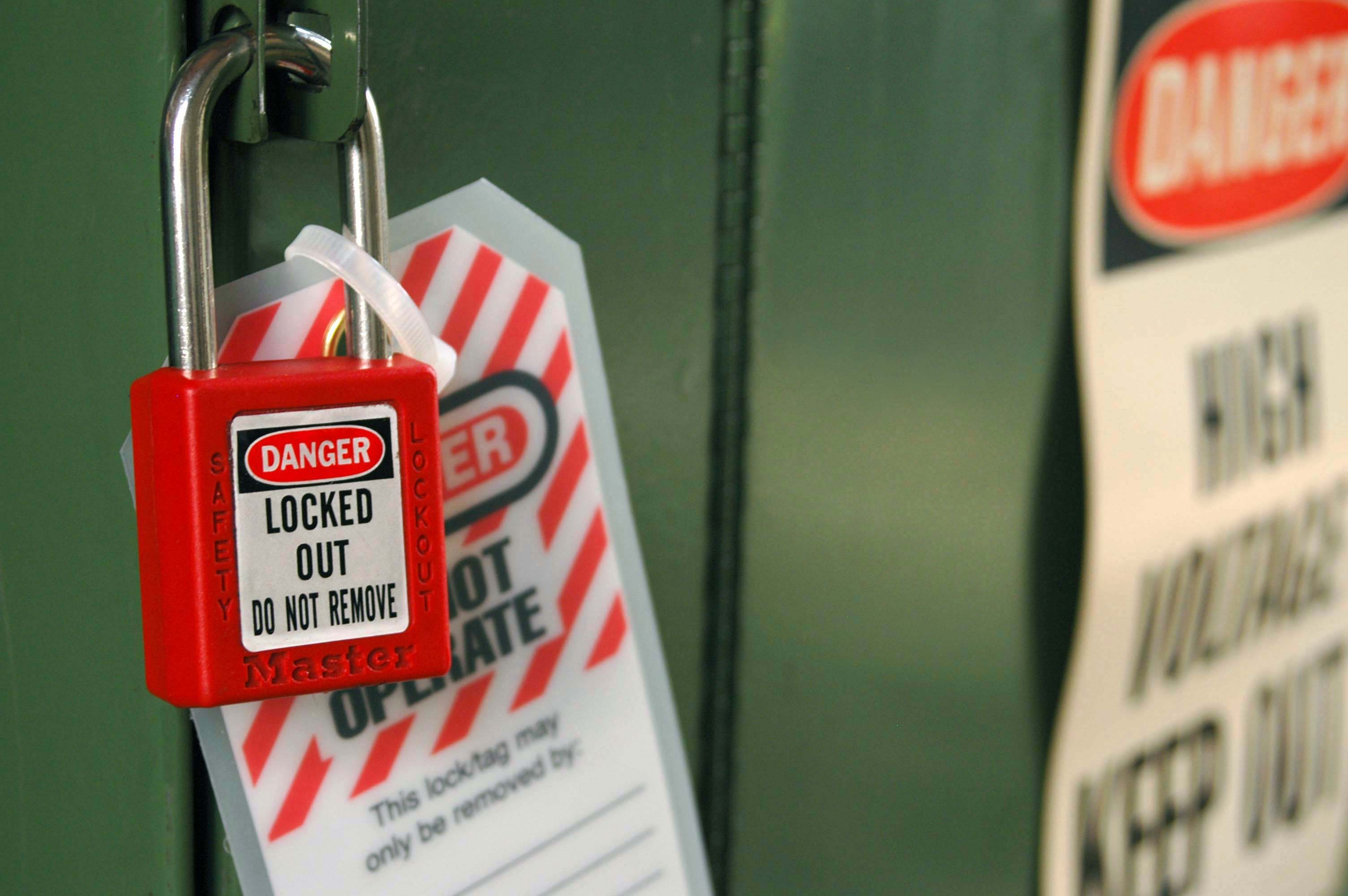
Expect Increased Lock Out Tag Out Try Out Enforcement
“MSHA will stress the importance of concentrating on effective lockout procedures by focusing additional resources on increased enforcement and education and outreach, including walk-and-talks….Metal and Nonmetal inspectors and Educational Field and Small Mines Services personnel will be visiting mines, discussing safe work practices with miners and reminding everyone to maintain their focus on safety.”
Lock Out Tag Out Procedures Must be in Your Standard Operating Procedures.
Lock Out Tag Out Procedures should really be known as Lock Out Tag Out Try Out. No machine is truly tagged out until you have tried to turn it on and nothing happens. MSHA is re-emphasizing their effort to make sure every person on a mine tries out a machine before they consider it safe to conduct work. Lock Out Tag Out Try Out should be an integral part of every company’s standard operating procedures.
What This Means For 2016
As we all know, MSHA is much more inclined to increase enforcement and fines than to educate. I’ve discussed MSHA’s inclination to attribute decreased fatalities with the recent increase in fines.
Review your Lock Out Tag Out Try Out procedures. Do they need updating? Now would be a great time to focus a morning safety meeting or toolbox talk on LOTOTO.
Make sure you emphasize Lock Out Tag Out Try Out in your MSHA training this year.
Stay safe everyone.
 You landed your first mine contract.
Great! … Now what? You’ve never dealt with mine safety regulations before and you’re overwhelmed with all the questions that need answers: What does MSHA stand for? What is MSHA? What’s the difference between MSHA and OSHA? How do I avoid these giant MSHA fines I’ve hears about? How do I get everyone in my company MSHA compliant and ready for work? What is MSHA training? What questions should I ask but don’t even know to ask?
The amount of info you need for MSHA compliance can be overwhelming, I absolutely agree.
The good news is you’re asking questions (and smart questions to boot).
The second part of the good news? You’ll get answers to all those questions (and more) on the Mine Safety Center’s site.

What Does MSHA Stand For? And What is MSHA?
MSHA stands for the Mine Safety and Health Administration. MSHA is an agency in the Department of Labor and was created when Congress passed the Federal Mine Safety and Health Act of 1977. MSHA strictly enforces the safety and health regulations (including the corresponding paperwork) within the Mine Act at all mining and mineral processing operations in the United States, no matter how big or small.
The Mine Act was the first time mine safety training became mandatory in the U.S. It also instituted many other essential safety rules through the 30 CFR Part 56 and 57 standards.
For more, here is former MSHA inspector and Mine Safety Center expert, Kim Redding:
What Is MSHA’s Mission?
MSHA’s mission is to prevent deaths and injuries at America’s mines. According to the fatality data they’re doing something right.
MSHA enforces the law through a mixture of inspections, education, and outreach. Since 2010 there has been a heavy emphasis on inspections and writing violations.
What is MSHA’s Contractor Authority? Does MSHA Regulate Contractors Too?
Does MSHA regulate contractors as well as miners? Yes, MSHA regulates anyone that conducts work on a mine, regardless of the type of work performed.
Note: A miner is any person, including operators or supervisors, who works at a mine and who is engaged in mining operations. This definition includes independent contractors and employees of independent contractors who are engaged in mining operations and any construction worker who is exposed to hazards of mining operations.
Everyone must comply with MSHA regulations, from the mine owner to the guys refilling the vending machines.
The Mine Act gives MSHA much broader oversight and stronger enforcement capability than OSHA. On an OSHA work site, a contractor may go his whole career without seeing an OSHA inspector. OSHA inspectors usually don’t show up unless there is a hazard complaint or an accident with a serious injury or fatality. But under the Mine Act, surface mines must be inspected no less than twice per year and underground mines are inspected no less than four times a year.
Officially, contractors must receive comprehensive training if they are exposed to hazards of mining operations for frequent or extended periods. But lately, MSHA seems to have expanded their definition of “frequent.”
Recently we’ve conducted a lot of New Miner MSHA training for contractors who have been doing jobs at the same mines for 20 years. Why? Mines are under pressure from MSHA. Last year MSHA declared an emphasis on contractor compliance and mines are attempting to make sure they have their bases covered.
MSHA and OSHA – What’s The Difference?
This is a big topic that deserves its own post. But I feel it should be briefly addressed here. The major differences between MSHA and OSHA are:
- MSHA has an Open Search Warrant for every mine in the U.S. You must let them inspect anything they request. If you refuse you get an automatic $50,000 fine and the inspector will come back with Federal Marshals
- A minimum of two inspections every year
- MSHA Inspectors can close a mine without a court order
- MSHA can institute civil penalties (also known as personal MSHA fines) against management that must be paid with their own money. It’s illegal for companies to pay civil fines.
- MSHA can institute criminal penalties for accidents even when an incident doesn’t involve a fatality.
- Miners may bring discrimination cases against a company based on safety complaints.
So What Is MSHA Again?
What does MSHA stand for? The Mine Safety and Health Administration. What is MSHA? MSHA was created to keep everyone working on a mine safe – and the fatality statistics show they have. But MSHA can also cost companies a lot of money if they’re not compliant.
That brings us to the next big question:
What do we need to do so we can start work? How do we get MSHA Compliant?

Mine Fatalities – 100 Years of Progress
Mine fatalities in the U.S. have dropped precipitously since the first regulatory agency was established in 1910. As 2015 comes to a close let’s look back and see the progress in 3 charts. All data comes from MSHA.gov.
The Long View
In 1917, 3,679 men left for work never to return home. The average number of mining fatalities from 2011 to 2015 was 38. While 1 life lost is 1 too many, we must acknowledge the astounding progress in mine safety. Fatalities have decreased nearly 10,000% in less than 100 years.

Click to enlarge
The sheer number of mine fatalities in the early 20th century is staggering. On average 2866 mining deaths occurred every year between 1915 and 1930, nearly 8 each day. 8 families losing a father, son, or brother every day. That’s unimaginable now.
Mine Fatalities After the Mine Act
The Federal Mine Safety and Health Act, or Mine Act, was passed in late 1977. This large and important piece of legislation brought all U.S. mines under federal jurisdiction and implemented a significant number of safety regulations. The Mine Act has far-reaching ramifications throughout the U.S. mining industry.
Significant provisions include:
- Mandatory safety training
- Annual inspections of all surface mine
- All underground mines are required to have mine rescue teams
Let’s take a look at mine fatalities in the decades since the Mine Act was enacted:
Click to enlarge
A substantial effect is apparent. Since the Mine Act’s passage, deaths have significantly decreased. Mine fatalities dropped by 53% from the decade before the Mine Act was passed to the decade after.
Before the Mine Act:
Average of 356 mine fatalities per year between 1967 and 1976
After the Mine Act:
Average of 189 mine fatalities per year between 1978 and 1987
Progress Since 2000
Finally, let’s look at the beginning of the 21st century.

Click to enlarge
Another significant drop. Mine fatalities have gone down 63% from the first half of the century to the second. From 85 deaths in 2000 to 45 in 2014 and 25 in 2015.
Substantial progress has been made, but even one death is too many. Mine operators and employees will continue to work towards that goal.
MSHA New Miner Training: Where To Begin?
There are several training requirements everyone must complete before they are given MSHA Part 46 certification and cleared to work on a mine. For a person who has never worked on a mine the first requirement is MSHA New Miner Training.
In this post, I’ll discuss the requirements of Part 46 new miner training. I’ll go through the Part 48 requirements in a later article. If you’re unsure whether you need Part 46 or Part 48, you need a definitive answer as soon as possible. You can find out if you need Part 46 or Part 48 training by answering a few, simple questions.
Who Should Take An MSHA New Miner Training Course?
- Newly Hired Mine Employees
- Construction Personnel
- Maintenance Personnel
- Mine Contractors
To meet MSHA certification training requirements under Part 46, new miners must receive at least 24 hours of mine safety training from a “Competent Person” designated in their Part 46 Safety Training Plan.
MSHA New Miner training must include a minimum of four hours of instruction in nine specific areas before a new miner can begin work.
MSHA New Miner Training Requirements: Mandatory Topics
- Introduction to the work environment, mine tour, mining methods and operation
- Instruction on recognition and avoidance of hazards
- Emergency procedures, escape, and firefighting
- Health and Safety aspects of the tasks assigned
- Instruction on statutory rights of miners and their representatives
- Authority & responsibility of supervisors and miners’ representatives
- Introduction to the rules and procedures for reporting hazards
- First Aid and CPR
- Introduction to the mine’s Hazard Communication program, or HAZCOM.
Part 46 regulations require at least 4 hours of MSHA new miner training prior to the trainee working on-site. This initial training allows the miner to work on a mine site under the observation of an experienced miner while they complete the rest of their MSHA New Miner training. Most companies will have trainees complete at least 8 hours of classroom training.
Part 46 also has time restrictions, though they generally aren’t an issue. The trainee must complete first aid/CPR training within 60 days of starting their training. The trainee must also complete their entire MSHA new miner training within 90 days of starting the training.
Where can you complete the classroom requirements of new miner training?
That depends on your needs. You can hire an MSHA trainer to come to your office. You can find a local class to attend. Or you can move at your own pace by completing large portions of your MSHA new miner training online.
What about the other required hours?
The remaining hours of training cover topics that teach health and safety at the mine. On the job training is not mandatory but highly recommended. Other required training includes:
- Task Training
- Site-Specific hazard training
How do you complete the rest of your MSHA training? Get step-by-step instructions through all the required MSHA training and paperwork. Download your free Contractor Success Kit to speed up and simplify your MSHA compliance.

Once all of your training is complete, what’s the next step? As soon as anyone finishes new miner training, they need to correctly and completely fill out their Part 46 New Miner certificate. And (of course) it’s a bit more complicated than it sounds.
Click here for a step by step guide to correctly filling out your new miner training paperwork.

Does MSHA Training Expire? Yes, But…
“Does MSHA training expire?” It’s one of our most asked questions. The short answer is yes. But as with most government rules there are exceptions and nuances. To remain compliant you must take Annual Refresher training every year.
The rules differ on how long you can go without taking Annual Refresher without starting from scratch. Depending on what the mine operation is pulling out of the ground you either need Part 46 or Part 48 training. Need a refresher on 46 vs. 48? You can learn the difference between Part 46 vs. Part 48 here.
MSHA Part 46 Training
Part 46 certification must be renewed every year with an 8 hour Annual Refresher training. There is a small amount of wiggle room. The training does not expire after exactly 365 days. You are compliant until the end of the calendar month one year after your last Annual Refresher training.
Need to read that again? Welcome to MSHA regulations. Let’s try that in plain English. If you finished your MSHA training (training complete, with the certificate signed and dated) on January 3rd you have until the following January 31st to finish your next Annual Refresher training. Or you could make your life easier and use Mine Safety Center’s online MSHA training. Our system will send you an email 60 and 30 days before your MSHA training is due.
Want more MSHA compliance tips from a former MSHA inspector? Download our Free Contractor Success Ebook. You’ll get the info and forms you need to get up to speed.
Does MSHA training expire completely if you don’t finish within the 1-year window?
No. You are no longer certified to go on a mine after 1 year-(ish) and you will need Refresher training if you plan on working on a mine during that year. But Part 46 training doesn’t fully expire until 2 years after your last MSHA training. At this point, you don’t need to start New Miner training from scratch.
This can be useful for contractors. If you don’t have a mine contract one year you do not need to spend the time or money to take MSHA training. But you will need to make a choice at the end of the second year. If you or your employees don’t take a Refresher Training within 2 years you will need to re-take your 24 hour New Miner training and re-complete your New Miner Training certificates.
Part 48 MSHA Training
All of the above rules stay the same if you are working on a Part 48 surface mine.
But underground Part 48 mines have different regulations.
30 CFR Part 48 states that an individual who receives 40 hours of training and works for 12 months as an underground miner is considered an “experienced miner.” MSHA rules require any experienced underground miner who has been away from mining for more than five years receive 8 hours of “experienced miner” training before returning to the mine.
You will need to re-take 40 hours of “new miner” training from a blue card certified trainer if you do not have the 12 months of mining experience. Some States have additional training requirements for miners. Contact the appropriate agency in your state to learn if this applies to you.
So, does MSHA training expire? Yes, but the rules change depending on your specific situation.
One Last Thing
It’s essential to accurately complete your certificates and hold on to your training records, especially your New Miner certificate. There have been instances where contractors lost their New Miner certificate and were forced to completely retake their 24 hour training. For MSHA the proof is always in the paperwork. You can ensure your paperwork and company are MSHA compliant by downloading the Contractor Success Kit. This free Ebook walks you through the MSHA compliance step-by-step to make sure you’re protected.
Need more MSHA compliance info? Download our free Contractor Success Ebook.
MSHA Confined Space Enforcement To Increase Dramatically
I just received an alert on MSHA confined space enforcement that needed to be passed along. Due to recent serious injuries and fatalities MSHA will be “placing special emphasis on enforcing its standards related to entering bins, hoppers, silos, tanks, and surge piles… by focusing additional resources on increased enforcement attention, education and outreach, including walk-and-talks,” said Neal Merrifield.
This MSHA confined space enforcement emphasis is just the latest in a long line of MSHA attempts to increase mine safety through fines and enforcement. The mining community needs to prepare for the imminent increase in MSHA enforcement. To help mines and mine contractors get ready and keep workers safe we’re offering our full Intro to MSHA Confined Space training for free.
The following is the full letter regarding the MSHA Confined Space Entry Alert from MSHA M/NM Administrator Neal Merrifield. All emphasis is added.
Unsafe work in confined spaces has led to miner deaths and injuries in the metal and
nonmetal mining industry. Recent tragic incidents include: a fatality while cleaning the
inside of a tanker railcar and a miner being severely burned during maintenance inside
a baghouse screw conveyor hopper. To address these regrettable occurrences and
help prevent similar instances in the future, MSHA will be placing special emphasis on
enforcing its standards related to entering bins, hoppers, silos, tanks, and surge piles.
MSHA and the Industrial Minerals Association-North America (IMA-NA) have engaged
the issue of confined spaces as a project within the Alliance between the two
organizations. We recommend conducting a hazard assessment and implementing a
permitting system as part of a safe entry standard operating procedure (SOP).
Many mining and milling workplaces contain areas that are considered “confined
spaces” because, while they are not necessarily designed for people, they are large
enough for workers to enter and perform certain jobs. A confined space also has limited
or restricted means for entry or exit and is not designed for continuous occupancy.
Confined spaces include, but are not limited to, tanks, vessels, silos, storage bins,
hoppers, vaults, pits, manholes, tunnels, equipment housings, ductwork, pipelines, etc.
Metal and Nonmetal (MNM) regulations related to confined space that MSHA enforces
include: 30 CFR §§56/57.5001(a); 30 CFR §§56/57.5002; 30 CFR §§56/57.5005(c);
30 CFR §57.5015; 30 CFR §§56/57.14105; 30 CFR §§56/57.15005; and
30 CFR §§56/57.16002.
These standards regulate hazardous atmospheres; material that has the potential to
engulf an entrant; walls that converge inward or floors that slope downward and taper
into a smaller area which could trap or asphyxiate an entrant; and any other recognized
safety or health hazard, such as unguarded machinery, exposed live electrical wires, or
high heat.
Because confined spaces are potentially dangerous, employers should evaluate all
confined spaces in which their employees work to determine whether hazards exist or
whether the work to be done in the space can create hazards. MSHA will place special
emphasis on confined spaces over the next several months by focusing additional
resources on increased enforcement attention, education and outreach, including walk-
and-talks. We are encouraging the mining industry to do the same. MSHA will provide
the mining industry with additional information on the importance of having an effective
MSHA Confined Space Entry program. Please make sure that information gets distributed.
MNM inspectors, joined by Coal inspectors and Educational Field and Small Mines
Services personnel will be visiting mines, calling attention to these potentially hazardous
conditions and discussing safe work practices with miners. Please join MSHA and
IMA-NA in this special safety outreach and help us spread the word to the miners at
your operations. This is the time to be proactive. Assure that an effective Confined
Space Entry program is implemented, that miners are trained on program specifics and
are task trained to recognize and avoid hazards, so they can go home safe and healthy
at the end of each shift.
A link follows to an MSHA Confined Space Entry Alert recently published on MSHA’s website:
http://www.msha.gov/Alerts/confined-space-entry-ha1109.pdf. Also, for more
information on the confined space mining deaths that have occurred since October 2013 and
Please use the photos and descriptions to prompt discussions about fatalities and how to prevent them.
MSHA Training Summit Agenda Released- A Quick Analysis
The annual MSHA Training Summit was held on October 28th. The agenda was released 2 days later. Let’s take a look at some statistics that jumped out at us while going through the agenda.
- The unfortunate trend of injuries and fatalities on Part 46 mines continues. 3 of 5 fatalities in the 3rd quarter occurred on Part 46 mines. That’s 60% of all fatalities. All indications point to increased MSHA inspections and scrutiny on Part 46 training and compliance.
- Expect MSHA’s focus on contractor training and paperwork to continue. 2 of the 5 fatalities in 2015 Q3 were contractors.
- The majority of serious accidents also occurred on Part 46 sites. 3 of the 4 highlighted “serious accidents” occurred on Part 46 sites. 2 on mines and 1 at a cement plant.
- So far in 2015, MSHA has “visited” 780 mines. The splits of M/NM vs. Coal mines inspected will be interesting. MSHA recently announced they were transferring inspectors from coal to the M/NM side.
- Of those 780 mines, approximately half are classified as “small mines.” This continues MSHA’s trend from the past 2 years of focusing significant resources on small mines. Now would be a good time to audit your MSHA compliance and training records if you own or manage a small mine.
- MSHA has conducted 3,174 Training Plan Reviews.
- MSHA has also conducted 3,769 Training Program Field Reviews.
MSHA has already begun a “surge” on M/NM mines, dramatically increasing the number of inspections with an emphasis on Part 46 operations. Based on Joe Mains’ history, he will increase the number of inspections until injuries and fatalities decrease.
The MSHA Training Summit can be a good indicator of initiatives in the coming year, though it may feel like reading the tea leaves at times. It’s important to analyze what MSHA might highlight to prepare your company. You can see the full MSHA Training Summit agenda for yourself here.
Mining Truck Accidents Can Be Reduced
Have contractors or customers caused mining truck accidents or a near miss on your site? Are aggregate haulers climbing on their trucks at your mine? Do drivers outside their trucks pose a hazard at your mine? Do you have difficulty managing these outside truckers?
Following established rules and procedures is essential to reduce mining truck accidents and other unsafe incidents. These rules and procedures also apply to customers and contractors but are sometimes forgotten because these drivers are not on a mine as often as mine employees.
The Mine Safety Center has teamed up with CalCIMA to produce free materials to teach a few simple ways to stay safe on a mine. “The training materials include signs that will warn drivers of the most common customer truck hazards at mine sites,” said Mike Herges, safety manager at Graniterock and a co-chair of CalCIMA’s Safety & Health Committee. “We hope mine operators embrace these warning signs and they become the standard at all mines,” added Herges. The training materials include a video, postcard, and brochure that incorporate the warning and caution signs. They provide operators a variety of formats to reach drivers, brokers, and fleet managers.
MSHA Part 50 Compliance Will Be Heavily Scrutinized
MSHA Part 50 enforcement will be significantly increased starting today. In a previous blog we discussed how MSHA will increase the number of inspectors and inspections at metal/non-metal mines with a heightened focus on smaller “mom and pop” mines.
In recent weeks, MSHA Part 50 enforcement of Accident Reporting has also increased. MSHA believes there has been underreporting of accidents and injuries. To back up these claims, inspectors have begun to go through workman’s compensation paperwork. If MSHA finds a serious accident that wasn’t reported in 15 minutes they will issue a ticket of $5000 to $60,000.
What accidents or injuries fall under the MSHA Part 50 Immediate notification requirement? According to 30 C.F.R. § 50.10 operators “shall immediately contact MSHA at once without delay and within 15 minutes at the toll-free number, 1-800-746-1553, once the operator knows or should know that an accident has occurred involving:
- A death of an individual at the mine;
- An injury of an individual at the mine which has a reasonable potential to cause death;
- An entrapment of an individual at the mine which has a reasonable potential to cause death; or
- Any other accident.
The language “any other accident” is ambiguous but MSHA goes on to define an accident as:
- A death of an individual at a mine;
- An injury to an individual at a mine, which has a reasonable potential to cause death;
- An entrapment of an individual for more than 30 minutes or which has a reasonable potential to cause death;
- An unplanned inundation of a mine by a liquid or gas;
- An unplanned ignition or explosion of gas or dust;
- In underground mines, an unplanned fire not extinguished within 10 minutes of discovery; in surface mines and surface areas of underground mines, an unplanned fire not extinguished within 30 minutes of discovery;
- An unplanned ignition or explosion of a blasting agent or an explosive;
- An unplanned roof fall at or above the anchorage zone in active workings where roof bolts are in use; or, an unplanned roof or rib fall in active workings that impairs ventilation or impedes passage;
- A coal or rock outburst that causes withdrawal of miners or which disrupts regular mining activity for more than one hour;
- An unstable condition at an impoundment, refuse pile, or culm bank which requires emergency action in order to prevent failure, or which causes individuals to evacuate an area; or, failure of an impoundment, refuse pile, or culm bank;
- Damage to hoisting equipment in a shaft or slope which endangers an individual or which interferes with use of the equipment for more than thirty minutes; and
- An event at a mine which causes death or bodily injury to an individual not at the mine at the time the event occurs.
Additionally, “injuries not related to one of the twelve types of accidents mentioned in 30 C.F.R. MSHA Part 50 (50.2(h)), such as ordinary sprains, strains, minor cuts, minor burns, bruises or other injuries that are not life-threatening, do not require immediate notification. These types of injuries should be reported via the 7000-1 form under MSHA Part 50 regulations.”
What can you do to stay MSHA compliant and protect your company?
First and foremost everyone on your site needs to be prepared. Put standard operating procedures in place and practice those procedures. Everyone on site, including contractors, must know the physical address of the mine so they can call 911 and bring help as soon as possible.
Second, all employees must know the next steps to take in the event of an accident. Do they have first aid training? Do they have a first aid kit? Will they be able to care for someone until paramedics arrive?
Finally, you need to follow regulations and report all accidents as defined by MSHA Part 50 within 15 minutes of their occurrence.
If you have questions regarding accidents you may have had, you can email MSC at sales@minesafetycenter.com or call 602-956-6959 ext. 23. We may be able to help.